Magic Color Cards ⭐ Card Making Countdown 2026
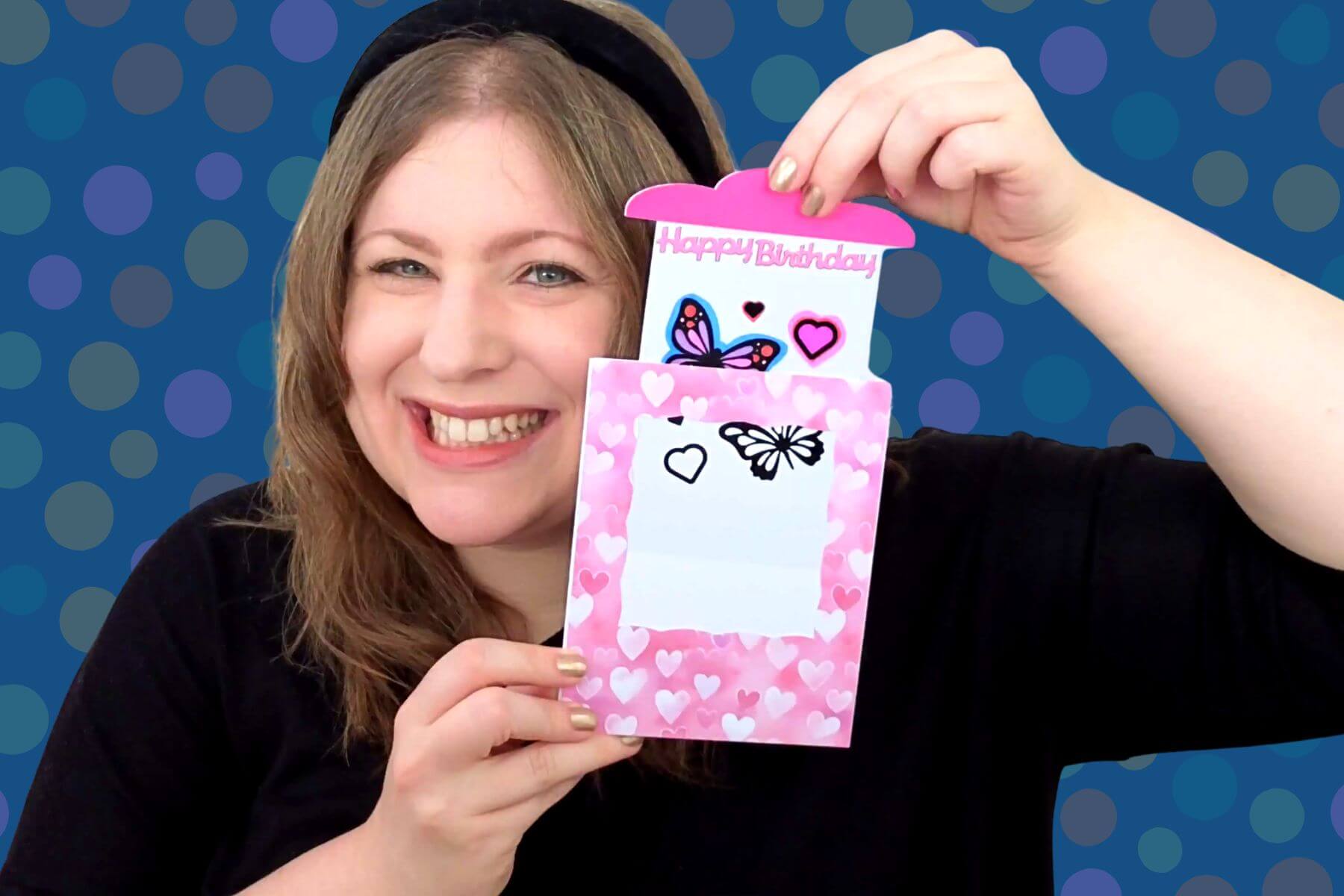
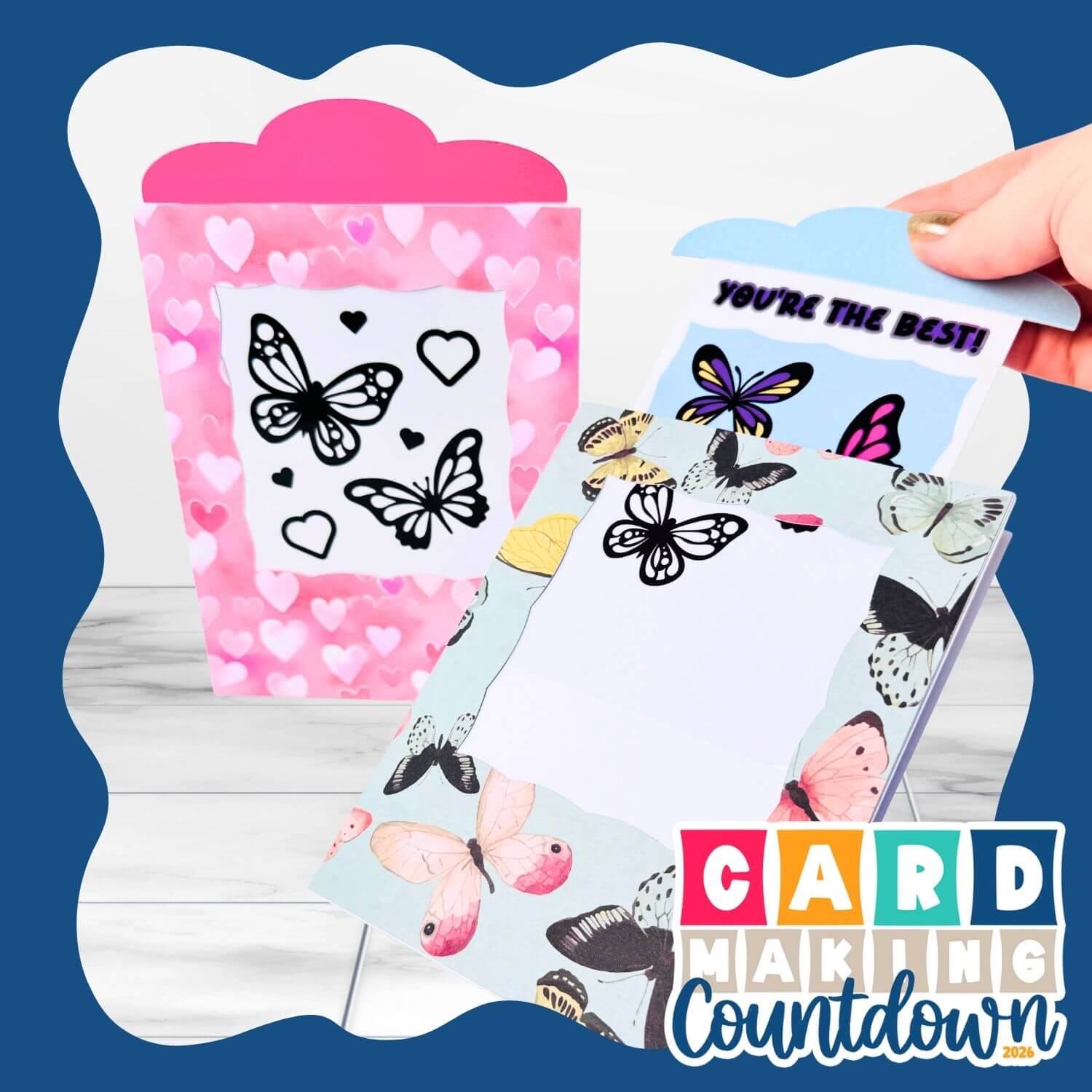
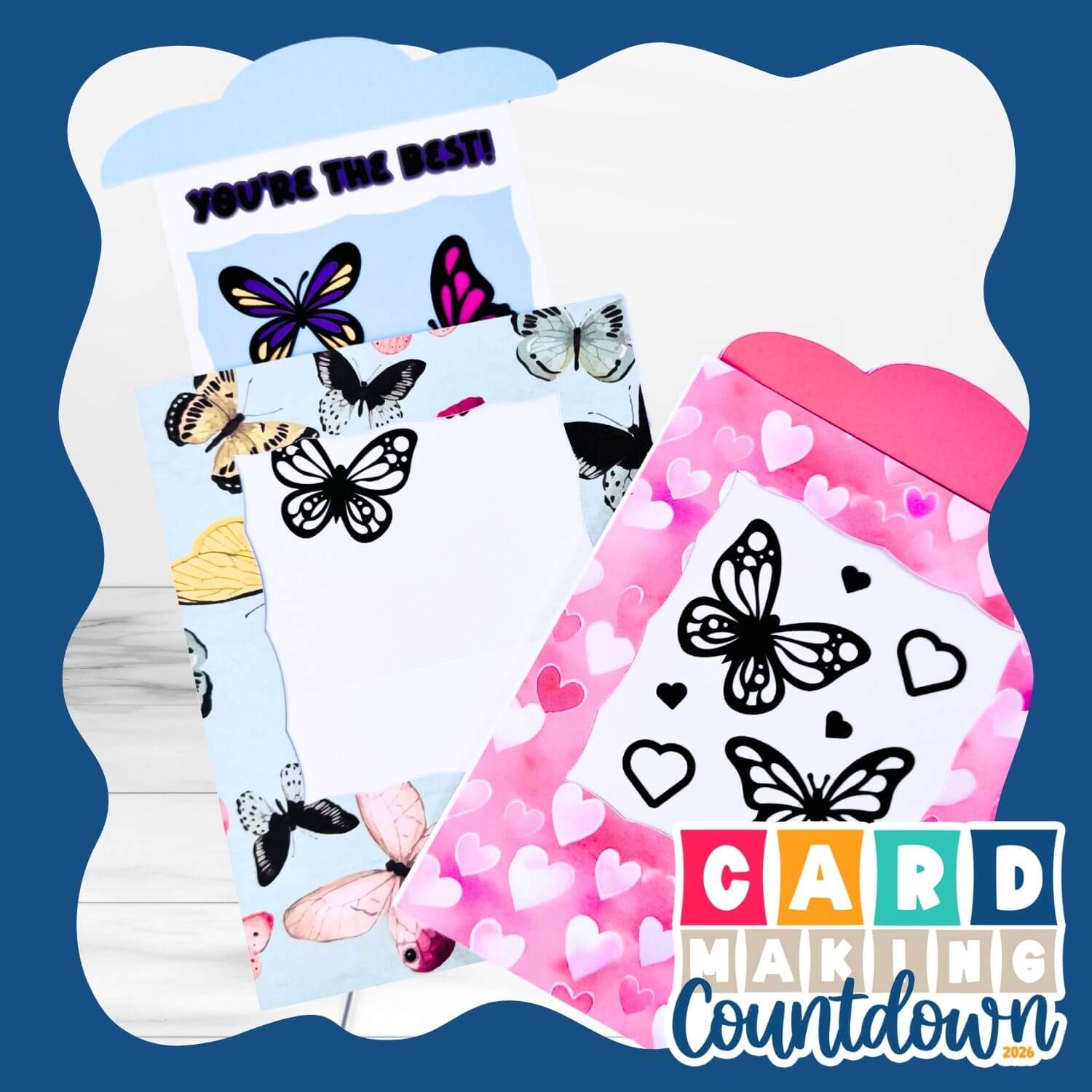
Add some color to your day with these clever magic “pull to reveal” cards.
Welcome to Day 11 of the 2026 Card Making Countdown.
Today’s project has a little magic touch. I’ll show you how to make fun magic color cards.
The front of the card shows a black and white image, but when the tab at the top is pulled, it reveals the color magically appearing underneath and a hidden message along the top.
There are two different methods for making this card.
The first version uses printable acetate and a colour printed in order to make the effect.
But you can also make the cards from regular acetate, adhesive vinyl and coloring pens, or with stamps from your craft collection instead.
Therefore, a printer is not necessary – there is an alternative to make the magic color card without one.
This project is part of the 2026 Card Making Countdown
Magic color card card supply list
Here is a list of the materials that are used to make this project.
Please note that some of the links included in this article are affiliate links, which means that if you click through and make a purchase I may receive a commission (at no additional cost to you). You can read my full disclosure at the bottom of the page.
- Cricut machine
- Light blue Cricut cutting mat
- Coloured cardstock (any thickness)
- Patterned paper (optional – for the background)
- Glue (I like Bearly Art Glue and Collall)
- Printable acetate, photo paper and a colour printer OR regular acetate and black adhesive vinyl and transfer tape OR regular acetate and stamps/ink
- Cricut scoring wheel or stylus (optional)
This project is suitable for the following types of Cricut machines: Explore series, Maker series, Joy Xtra, Joy and Joy 2. You will need to make it smaller to cut on the Joy or Joy 2.
This is the printable acetate that I used for my card. If you are planning to print your pictures then printable acetate is important, as the printer ink probably won’t ever dry on “regular” acetate.
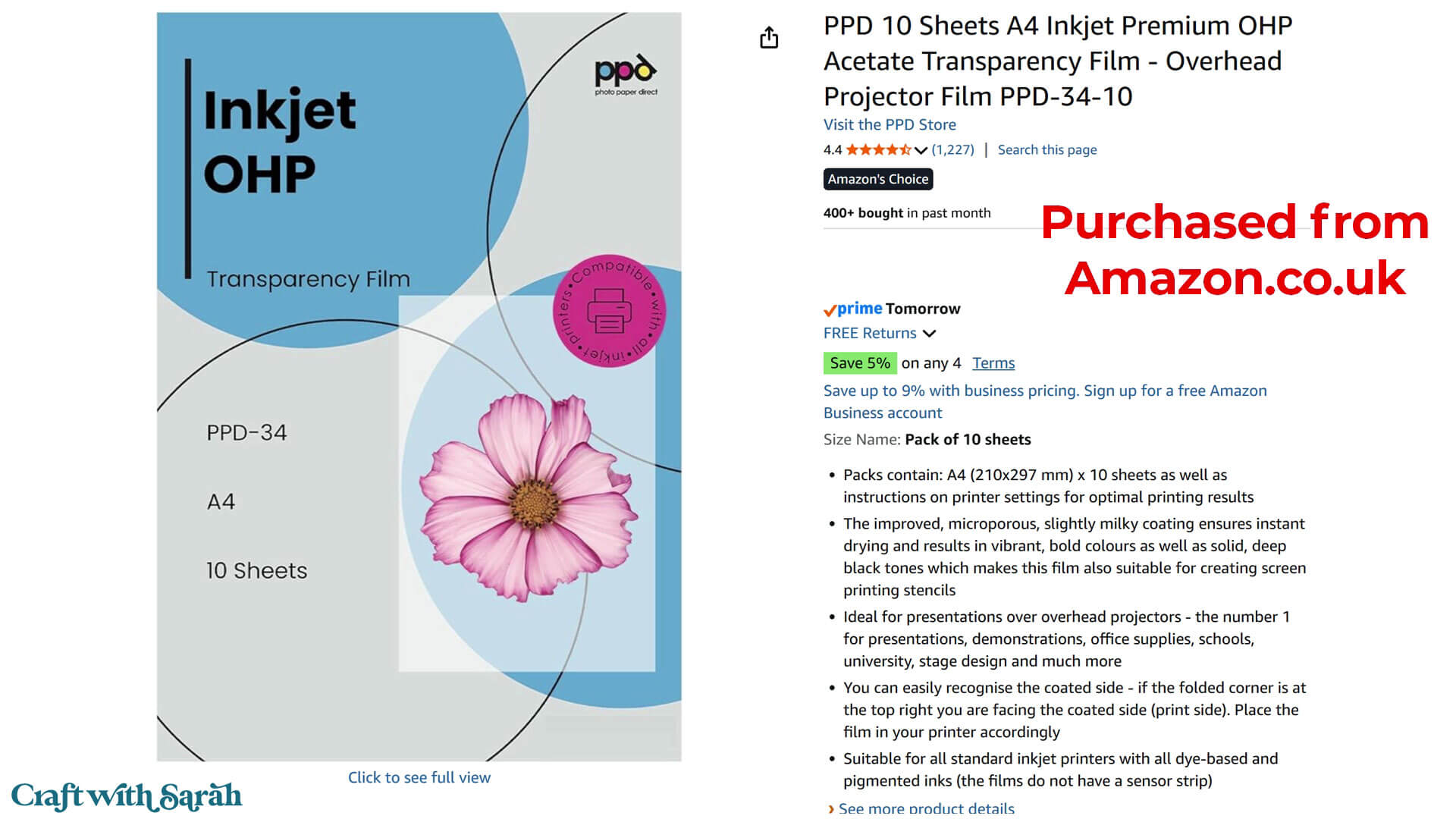
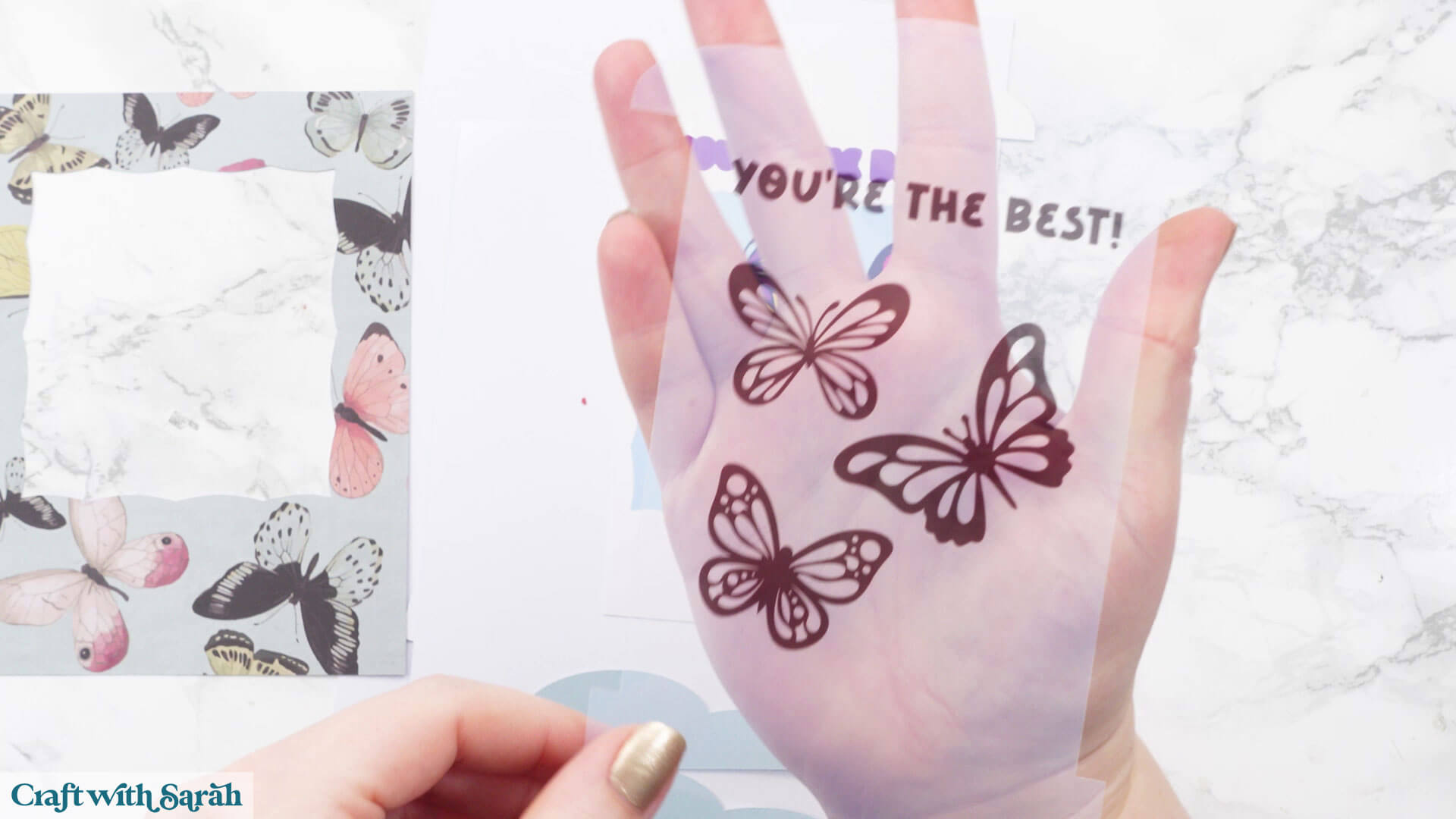
You’ll probably find that printable acetate has a “milky” colour and isn’t 100% transparent. That is ok and won’t make a difference.
Foundation learning
If you're new to making papercrafts with your cutting machine, check out these links to get you started.
They include videos on topics such as: which file to use with your type of cutting machine, how to load the files into your cutting machine's software, how to cut cardstock with your type of cutting machine, how to recolor and modify/customize the cut files and tips for displaying your projects.
- How to use zip folder downloads
- Help guides for Cricut machines
- Help guides for Silhouette machines
- Help guides for ScanNCut machines
The following tutorials are Cricut-specific, but many of the ideas will work similarly with a Silhouette or ScanNCut machine and any cut files that are shared in them are compatible with all types of cutting machine.
- How to score with a Cricut (even without scoring tools)
- Print then cut tutorial
- Design Space tools (Combine, Attach, Slice, Weld, Flatten, etc.)
- Pattern fill tutorial (for making backgrounds & cutting images to a specific shape/size)
- Free envelope SVGs that can be sized to fit any card
- Presentation boxes for handmade cards
- How to write inside cards with Cricut pens
- How to cut layered designs at a small size
- Design Space tips & tricks
- Cricut pens tutorial
- How to mount multiple designs in the same frame with magic guides
Magic color card video tutorial
Watch the video below to see how to make this project. Keep scrolling for a written tutorial.
IMPORTANT – Your project will look slightly different to mine as you will have two copies of one of the frame shapes, instead of the one that I used in my video. I tested it with two and it worked a little better to stop the acetate “jamming” when it slid back into the card.
How to make magic color cards
Step 1) Download the cutting files & upload to Design Space
Get the files using the box below.
Before you upload the SVGs to Design Space, you need to unzip the download folder that they come in.
Not sure how to do this? Click here for a tutorial that covers all the following types of computer and device:
- How to unzip a folder on a Windows computer
- How to unzip a folder on a Mac
- How to unzip a folder on an iPad
- How to unzip a folder on an iPhone
- How to unzip a folder on an Android device
After unzipping, upload the SVG file(s) into your cutting machine software.
Not sure how to use cut files with your type of machine? The following links lead to tutorials on how to use cut files in:
- Cricut Design Space
- Silhouette Studio
- CanvasWorkspace (for ScanNCut machines)
If you are using Cricut Design Space, start a new project and then click the “Upload” button on the left of the screen.
You can then either click “Browse” to find the files on your computer, or drag-and-drop them in.
Upload the file in the “Cutting Machine Versions” folder called svg-magic-color-card-craftwithsarah.svg
Press “Upload” on the next screen.
After uploading, the design should be automatically inserted onto your Canvas.
To hide the left sidebar (to give you more space for designing!), click the arrow that’s about half way down the page.
If the design doesn’t get inserted onto your Canvas, it will show under “Uploads” in your “Recently Uploaded Images”. Click on it and then press “Add to Canvas” to put it onto your Project.
Need help uploading SVGs? Get step-by-step instructions here in our detailed help guides for Cricut, Silhouette and ScanNCut.
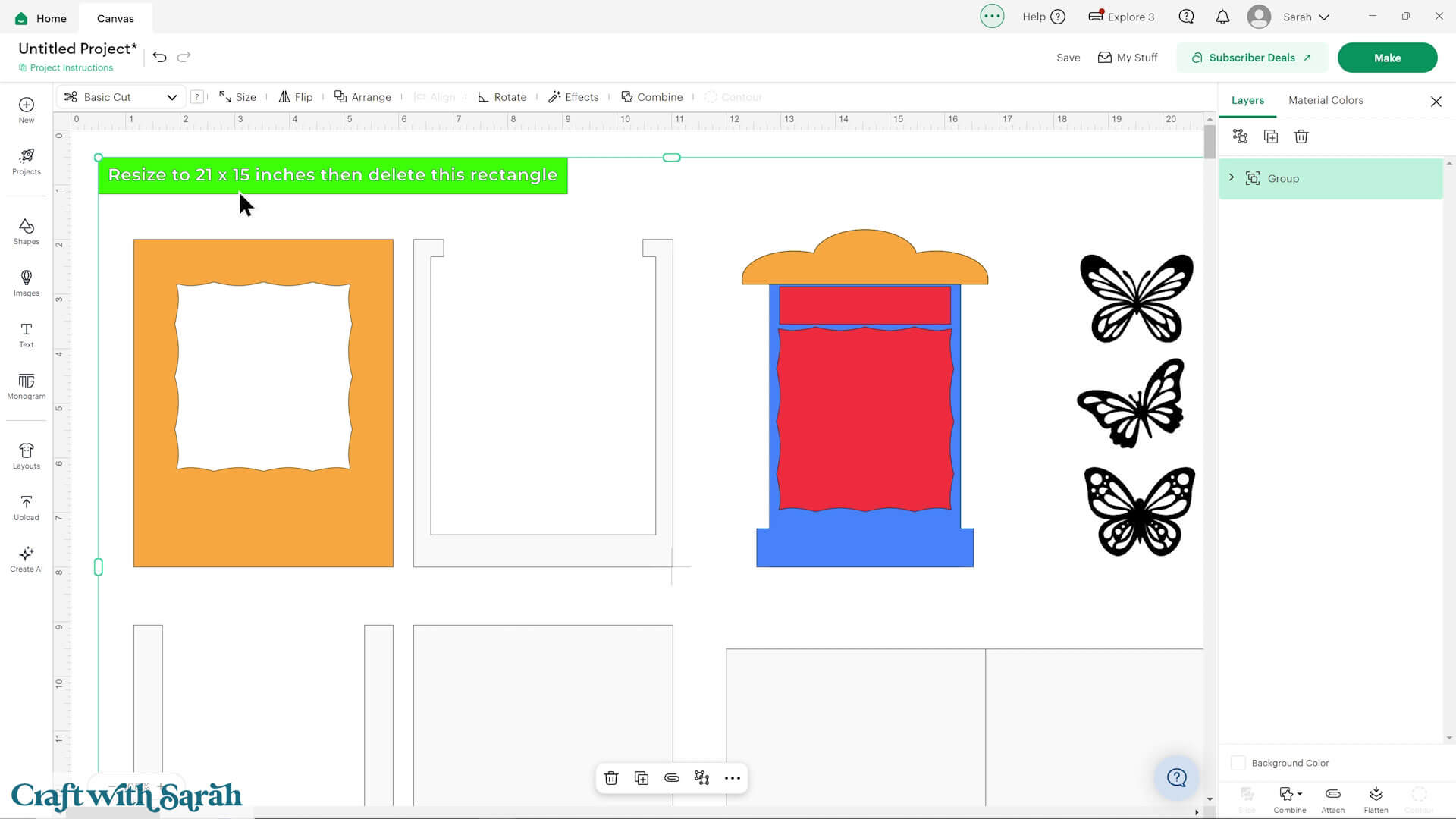
Here is what the design looks like loaded into Design Space.
IMPORTANT – Your project will look slightly different to mine as you will have two copies of one of the frame shapes, instead of the one that I used in my video. I tested it with two and it worked a little better to stop the acetate “jamming” when it’s slid back into the card.
Step 2) Project setup
Check the design has loaded in at 21 inches wide and 15 inches tall.
It will make a 5×7 inch card when finished.
Click the design and press “Ungroup” to separate out the different layers.
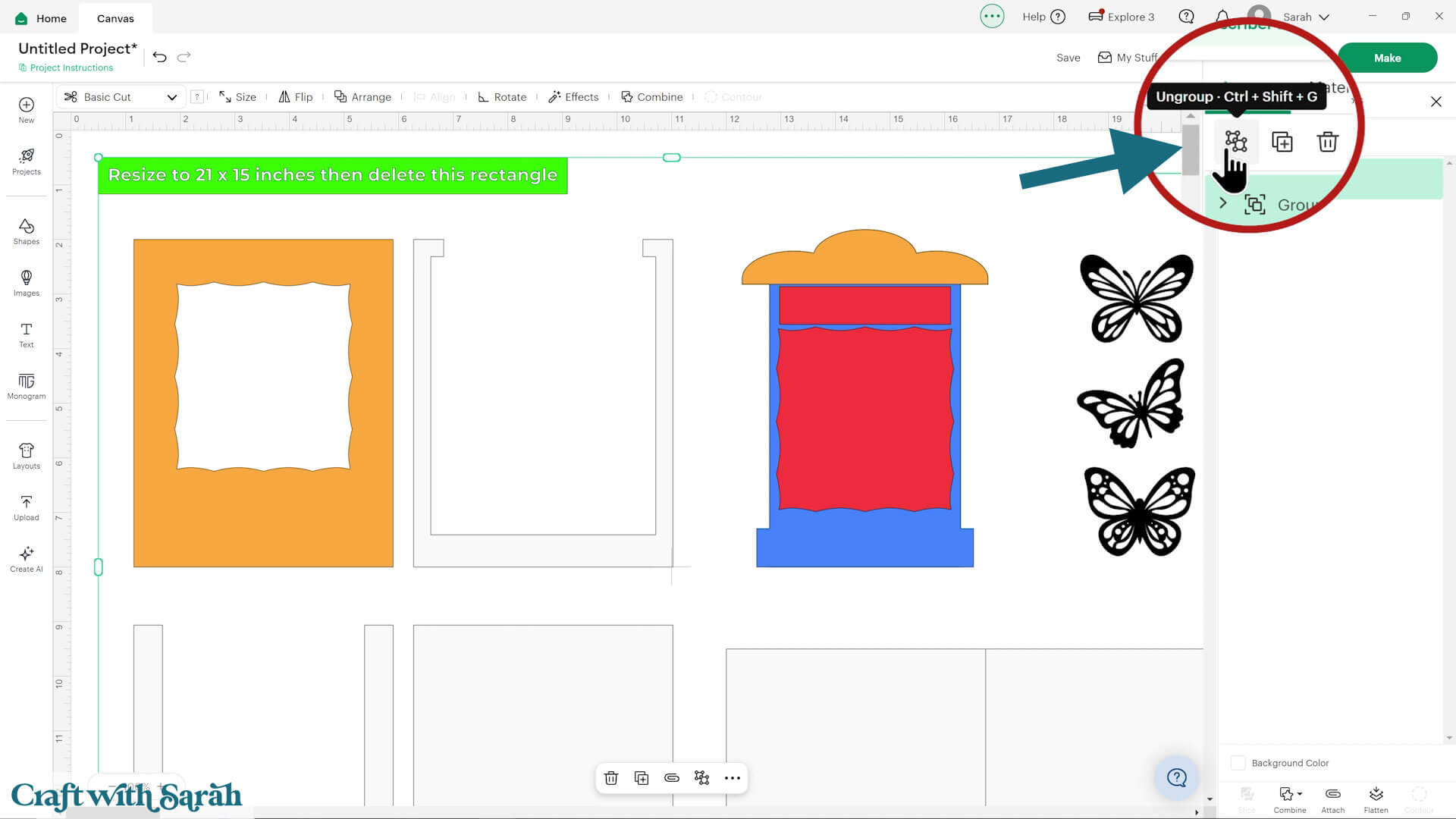
Click the green size guide rectangle and delete it.
First, change the main colours to match the design you will be making.
I changed the front of the card to lime green as I intend to cut it from patterned paper, and the lime green helps me to remember when cutting that it is the piece that needs the patterned paper to be loaded onto my Cricut mat.
My paper is a teal colour with butterflies on it, so I’ve changed the top and bottom tabs to teal too.
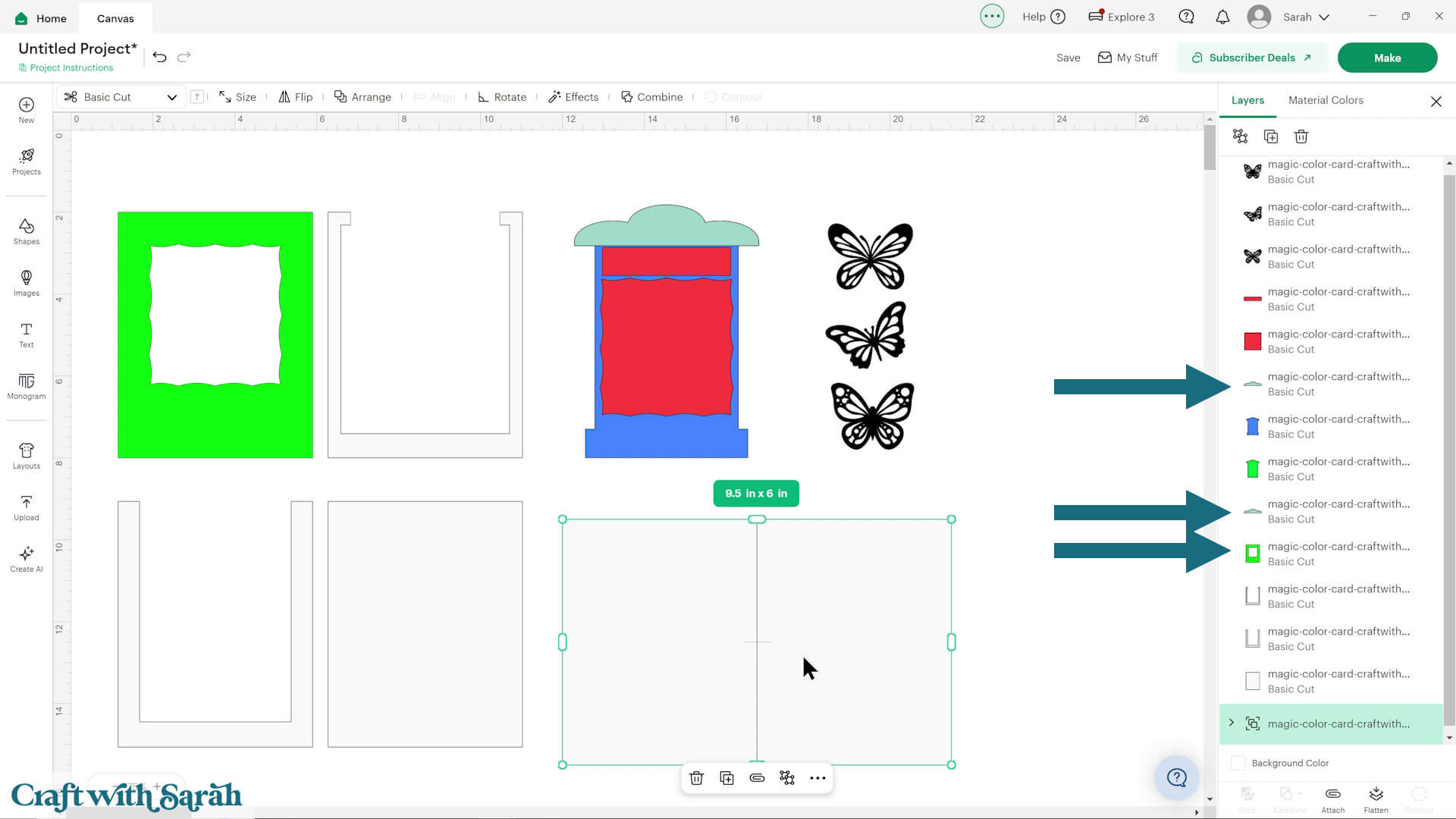
If you don’t have a scoring tool for your Cricut then delete the vertical line on the base card layer.
If you do have a scoring tool, click the chevon arrow next to the group name of the base card, then click to select just the vertical line layer.
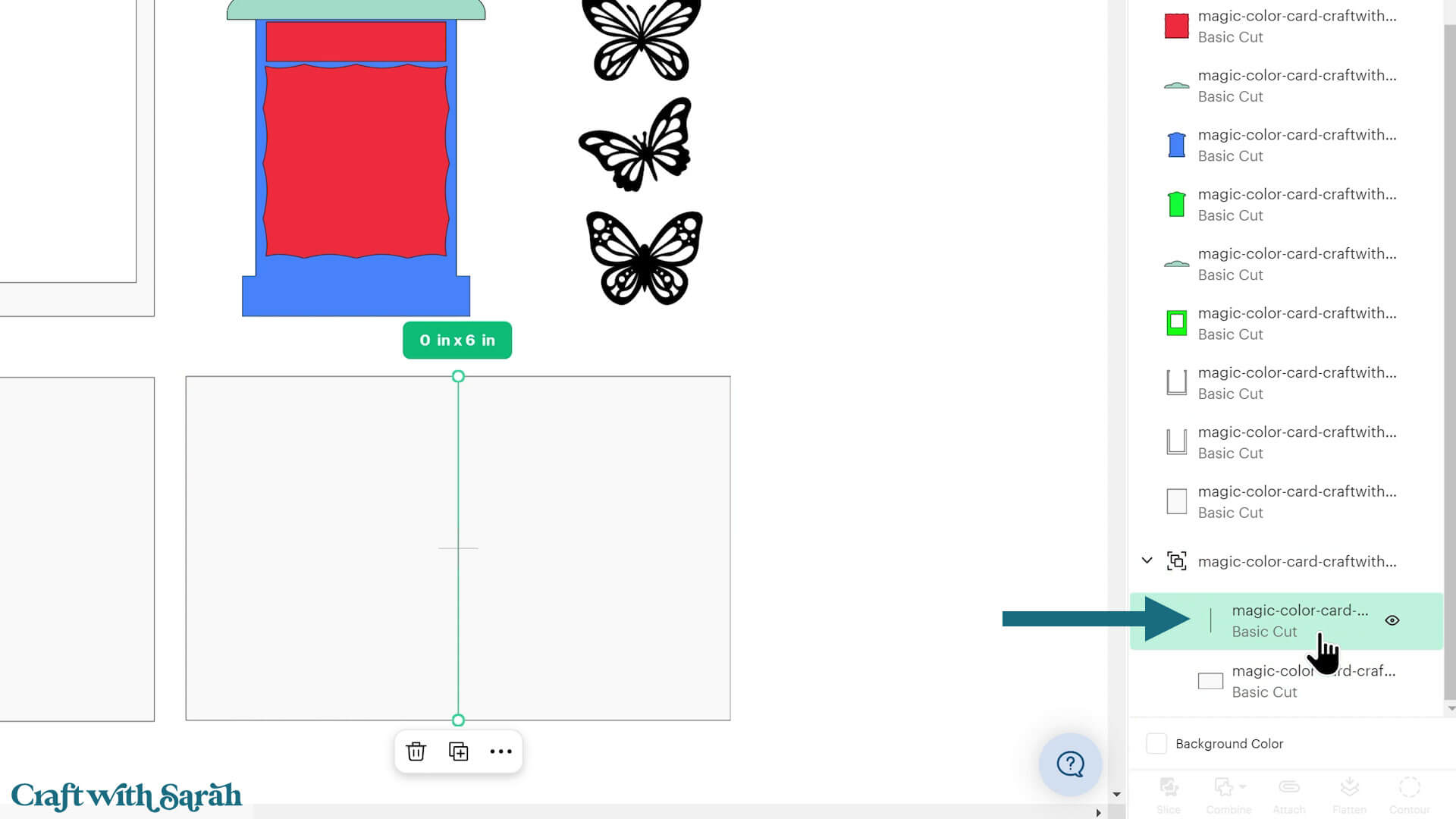
Change it to “Score” in the Operations dropdown menu.
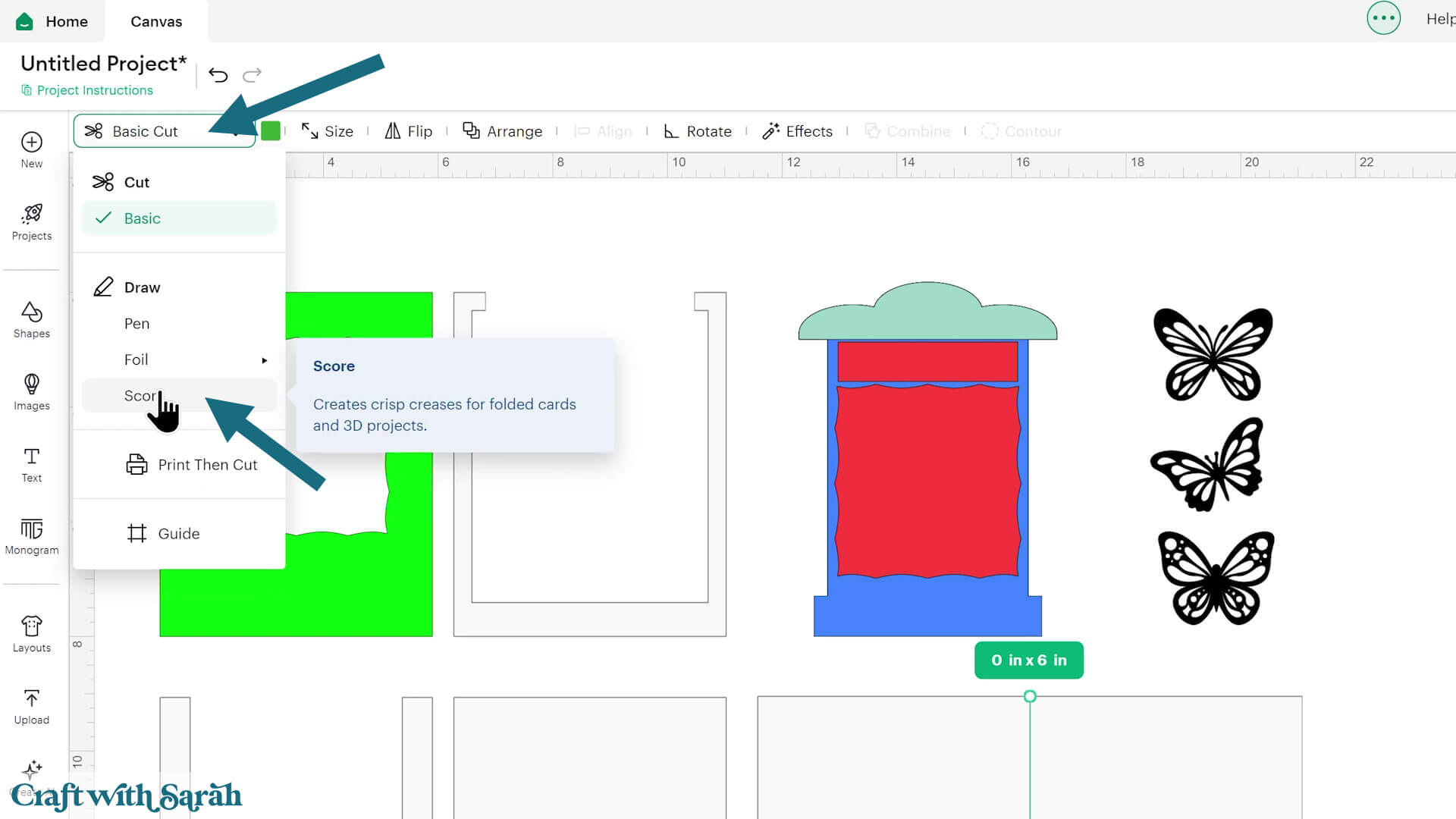
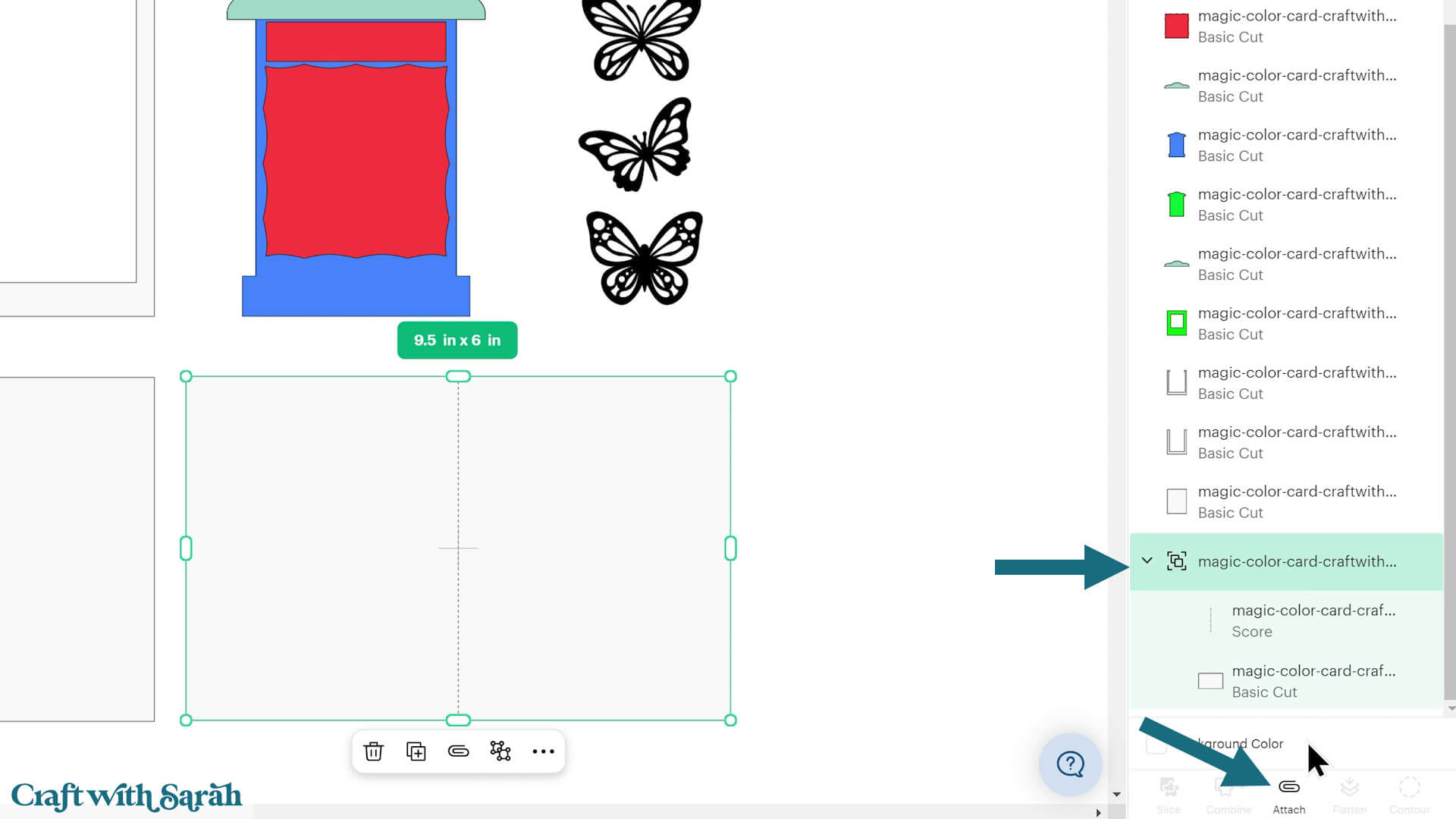
Select the group that contains the score line and base card, then press “Attach” to join the score line to the base card.
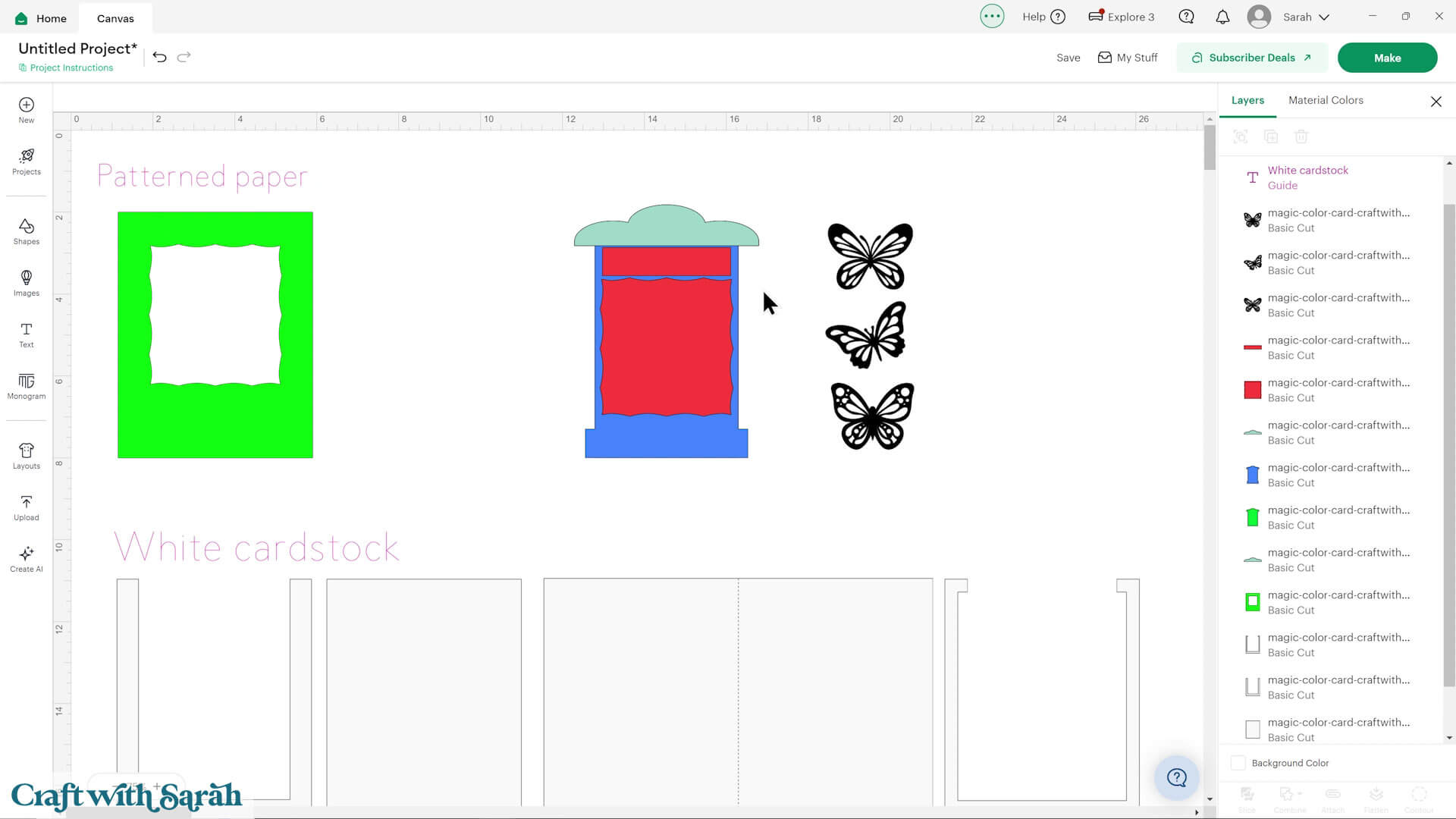
You may wish to add some text to remind you which parts should be cut from which material.
Change the text to a “Guide” in the Operations dropdown so that it won’t get cut out.
Next we’ll add the pictures to the card.
Zoom in on this section of the design:
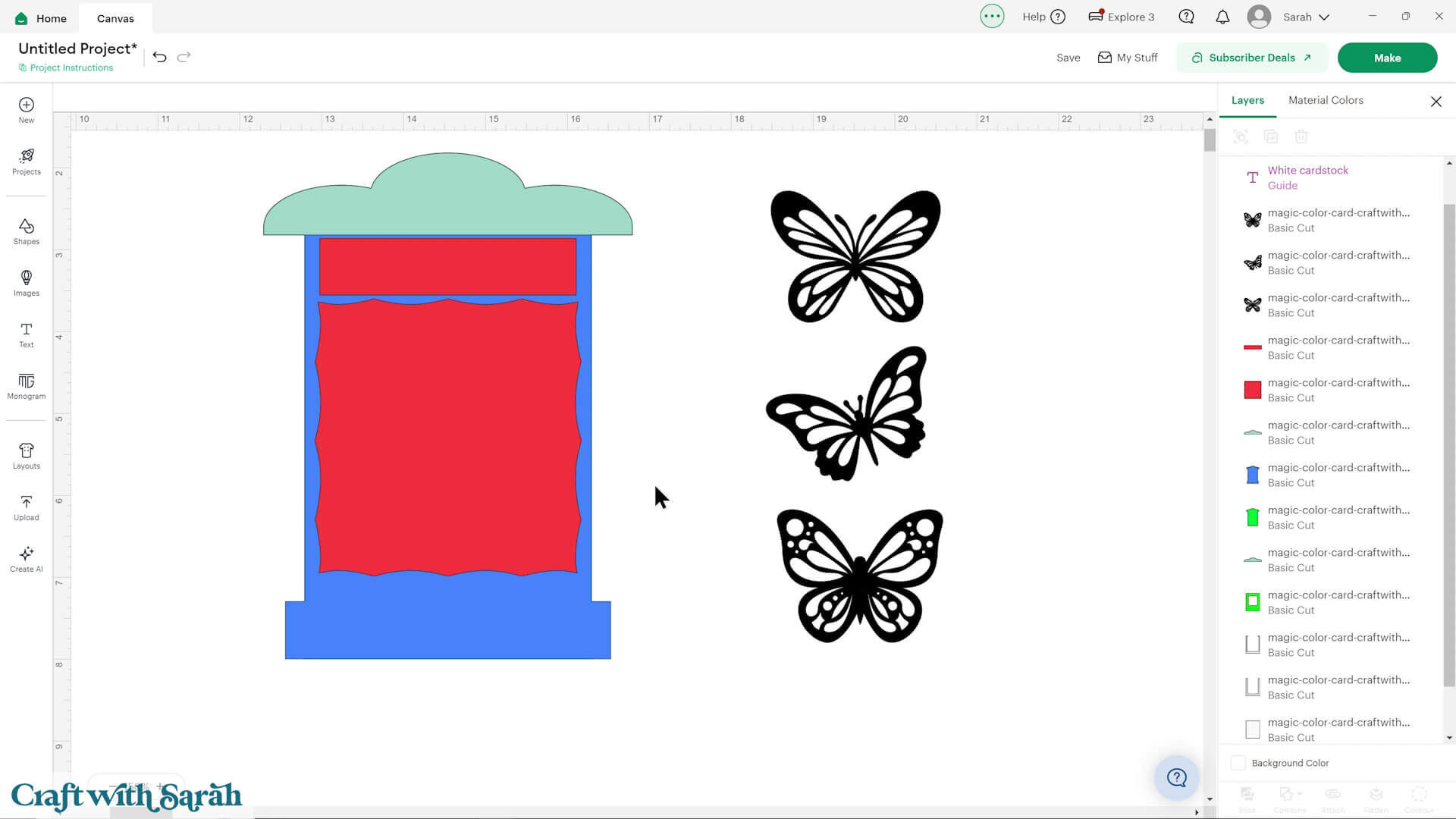
There are several different methods that can be used for adding pictures into the magic color card.
PRINTABLE ACETATE & COLOR PRINTER VERSION
First, I’ll show how to do it if you’re making the card with printable acetate, and printing the “coloured” pictures onto photo paper.
Change the two red pieces to “Guide ” layers. These are used to make sure your pictures will be visible when the tab is pulled up on the card.
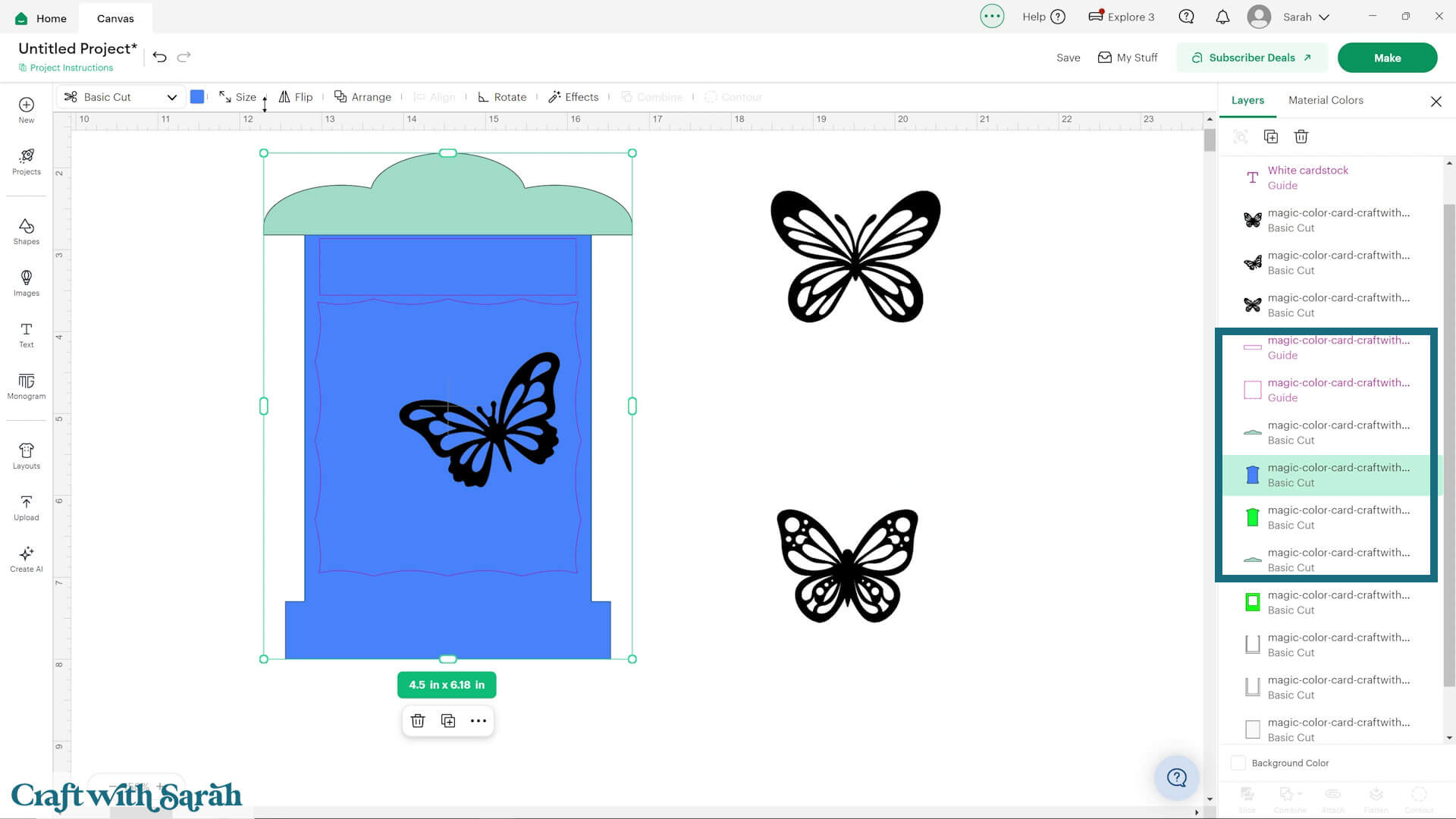
To make the project easier to see, hide the lime green layer and turn the blue one to a Guide too.
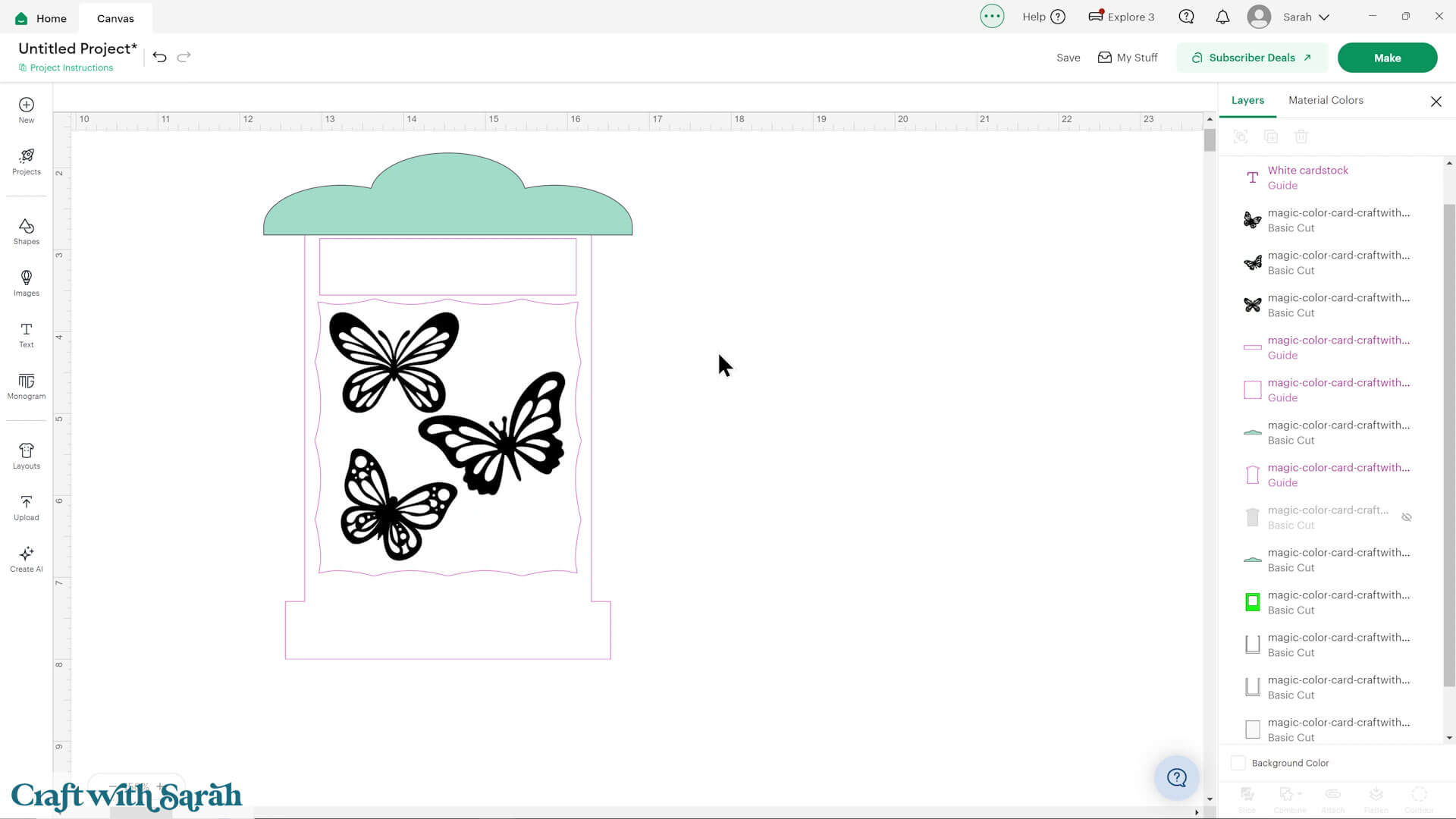
Position your chosen pictures inside the wavy lines. You don’t have to use the butterflies included – any black-outlined image is fine.
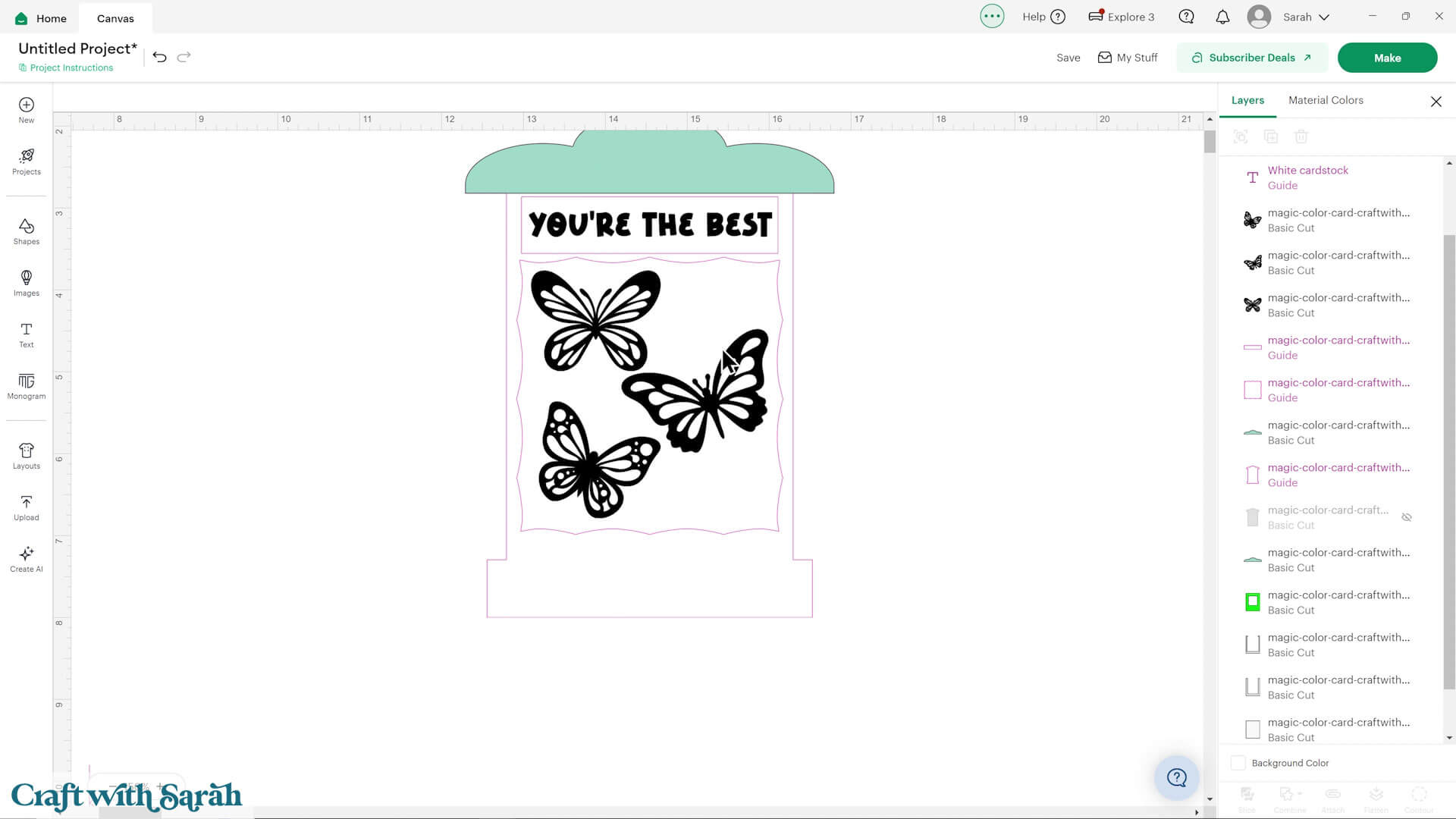
Add some text into the top rectangle Guide. Make sure it doesn’t go outside the lines.
Select your pictures and text (not the base pieces) and Group them.
Duplicate the group in place by holding your mouse over the group (on the canvas not in the layers panel) pressing Alt (Windows) or Option (Mac) on your keyboard and left-clicking.
That will make a copy of the group in the exact same place.
Hide one of the groups.
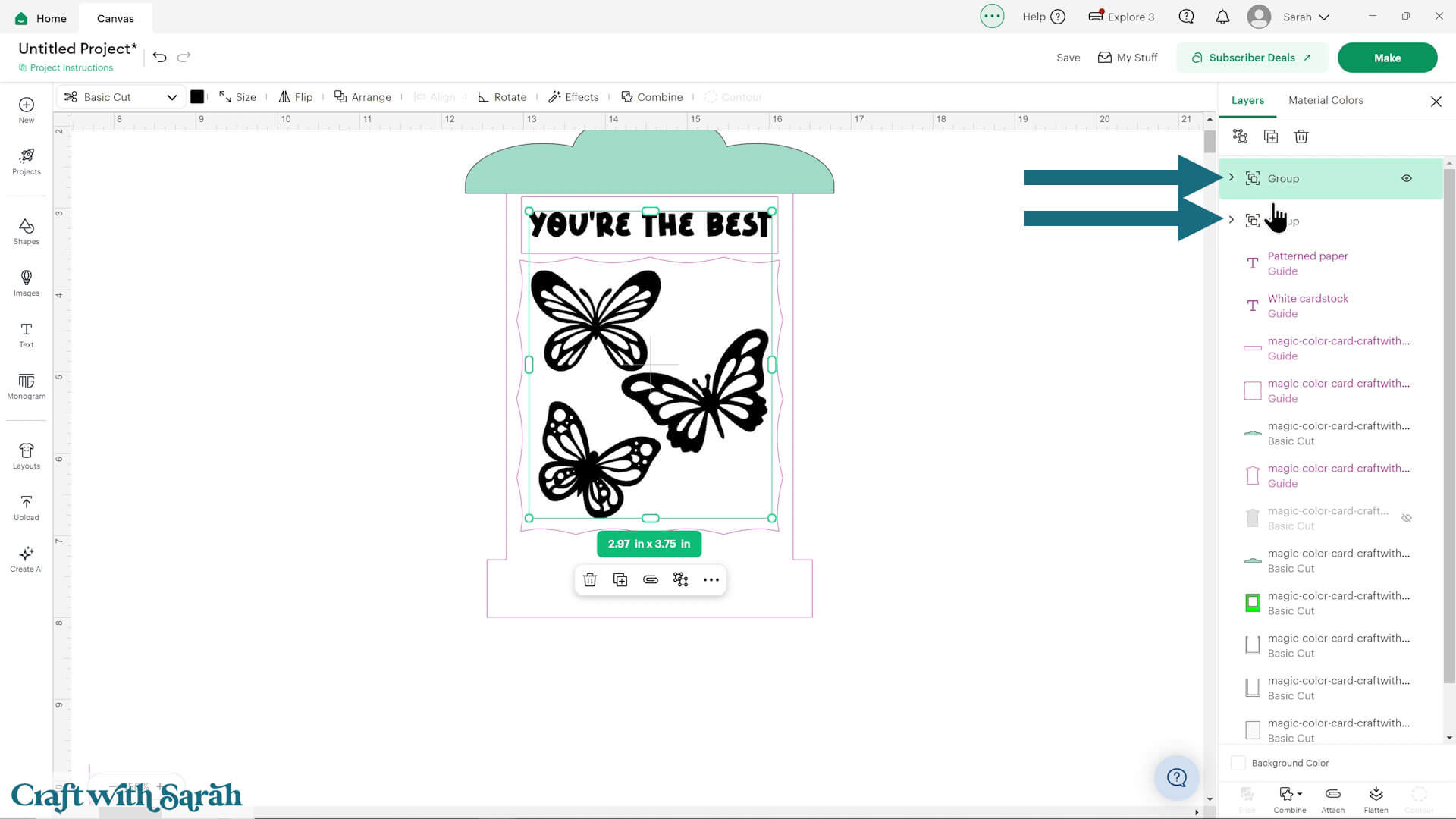
Ungroup the visible version of the pictures. This is the one we will add colour to.
You may wish to change the colour of the bottom guide that was previously red to add a background colour. I’ve chosen blue for the sky.
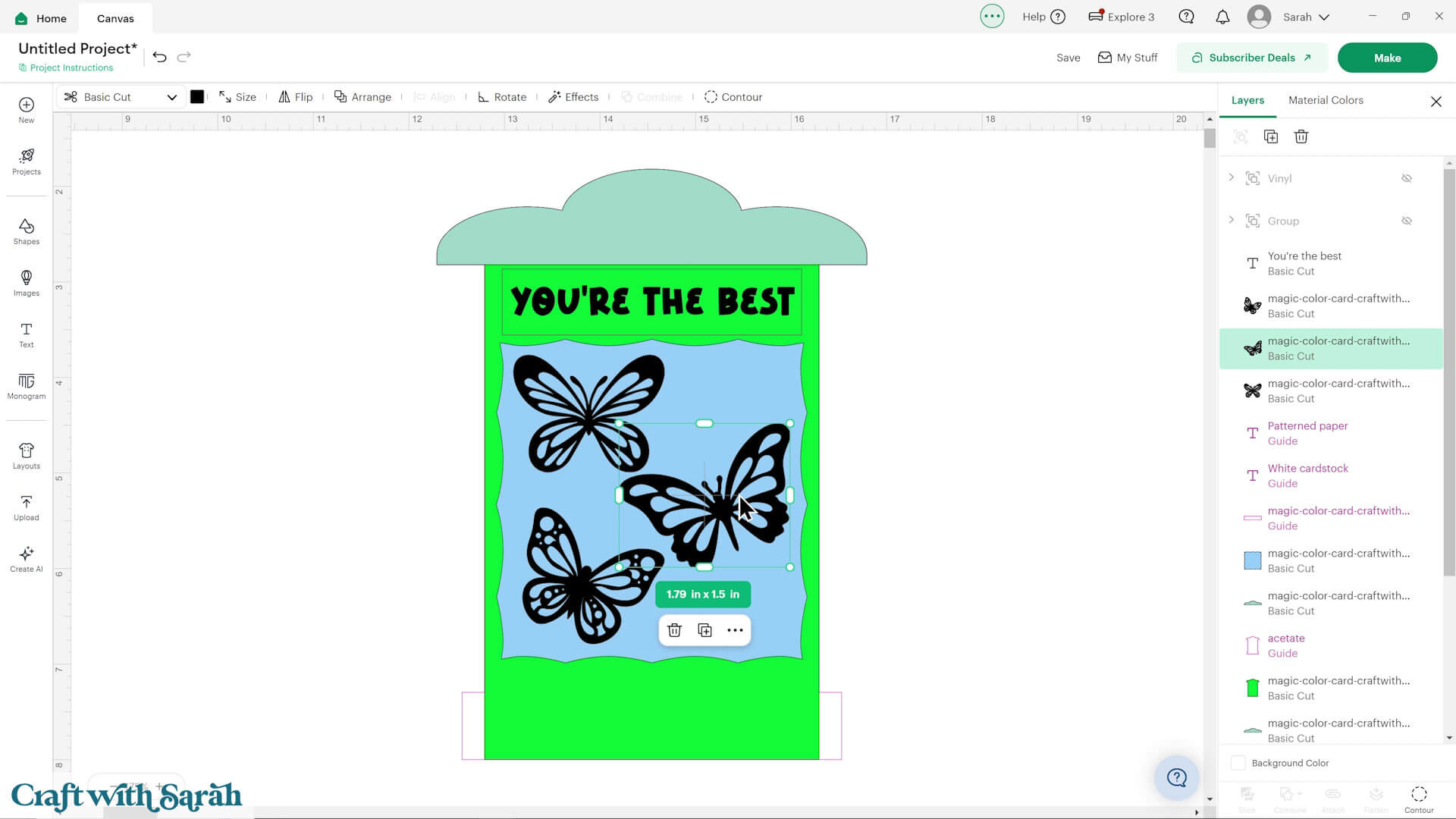
IMPORTANT – do NOT move any of the images, or the text, otherwise the pictures will not line up when the tab on the card is pulled.
Duplicate the pictures in place.
Change the colour, then click “Contour” and press “Hide all Contours” to fill in the shape with that new colour. Don’t forget to click “Apply” in the contour window.
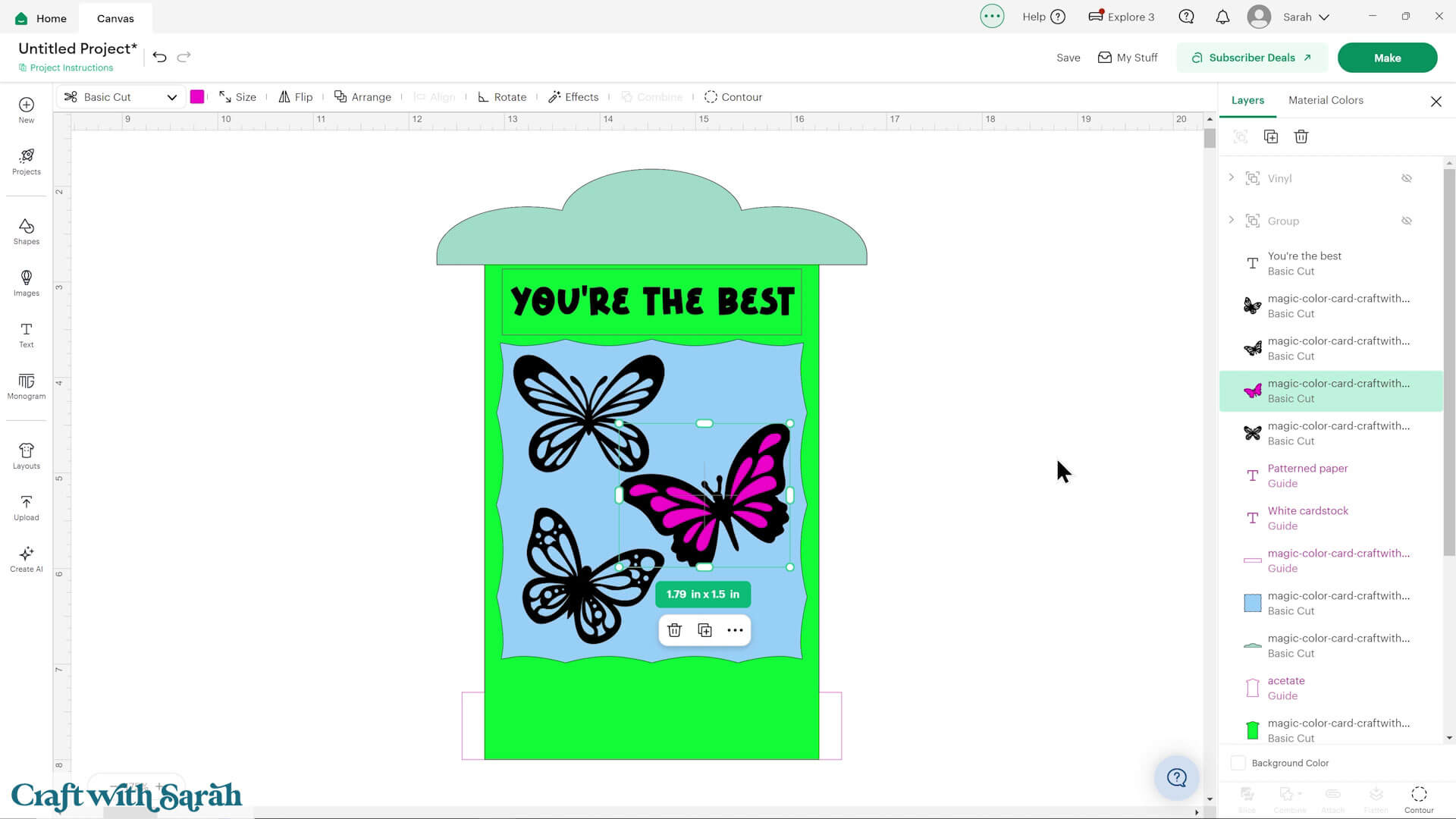
Repeat this for all your pictures.
You can duplicate multiple times and only contour out partial details to build multi-layered images.
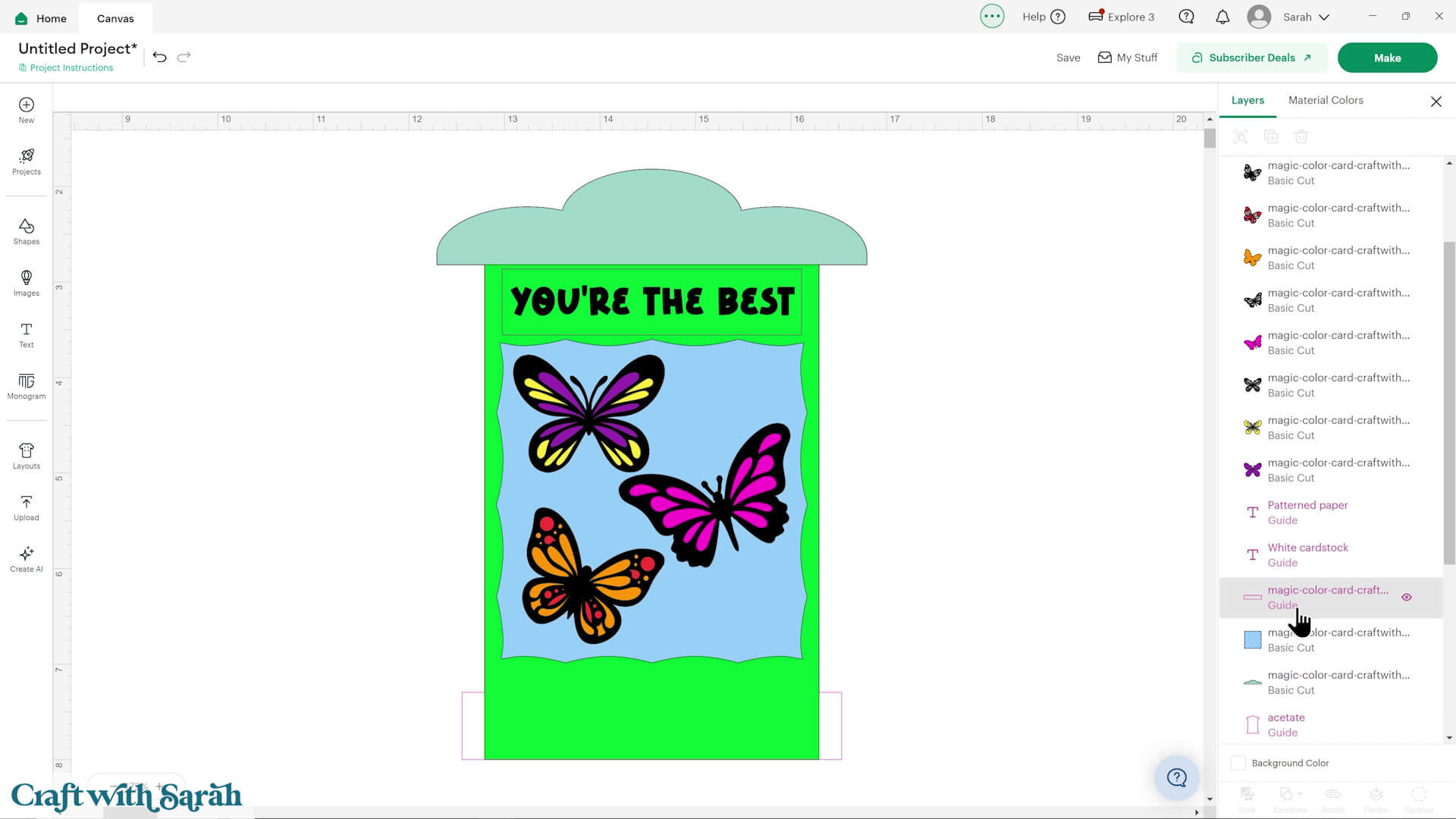
Create a border for the text with Edit > Offset.
I chose to hide the black text and only show the border/outline, but you can keep the black text showing if you prefer.
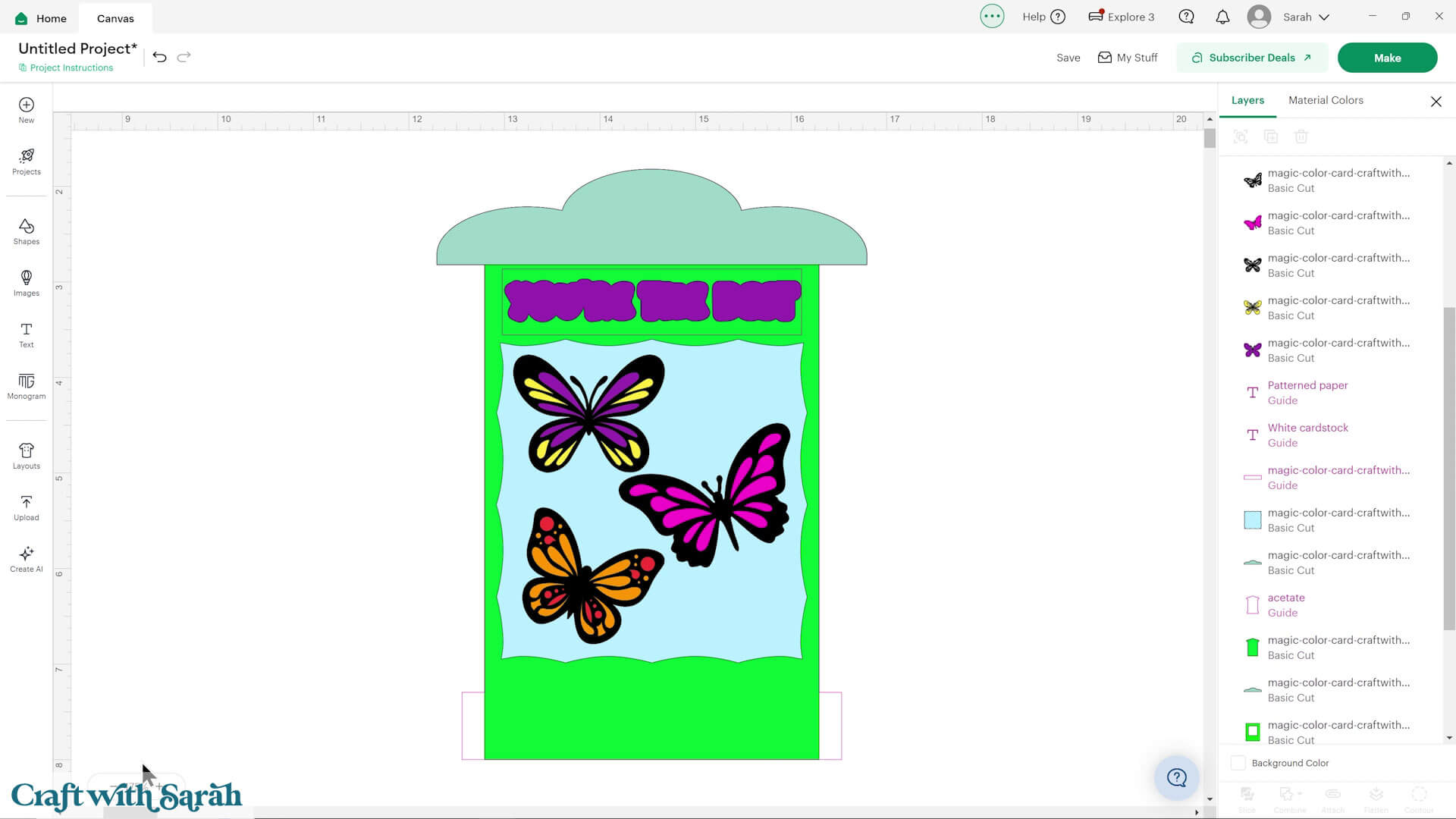
Change the lime green piece to white. This will be cut from photo paper.
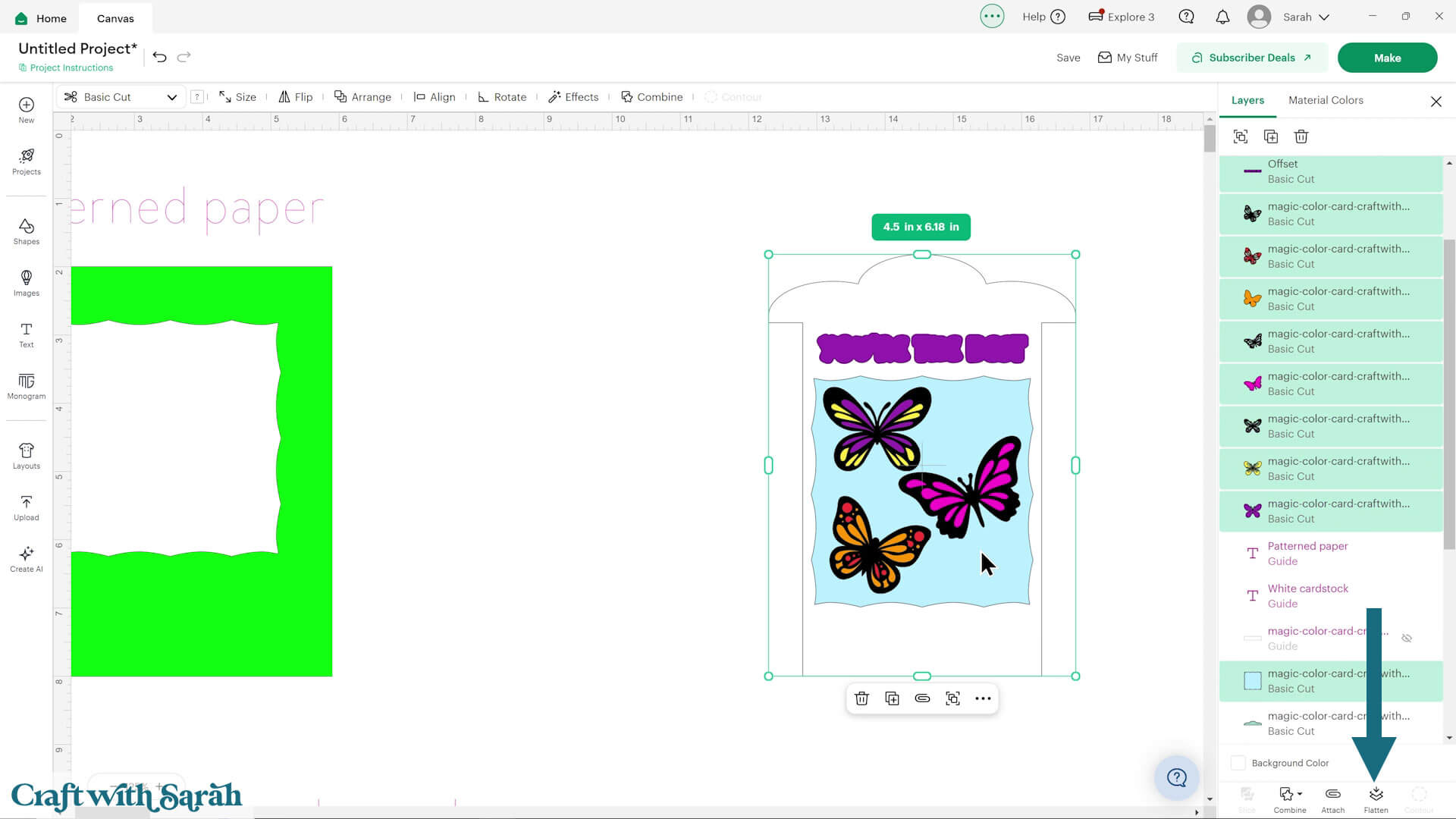
Select the white piece and the coloured version of the pictures and press “Flatten” to join them into one printable image.
After flattening, the border disappears from around the edge of the white piece, but don’t worry – it’s still there.
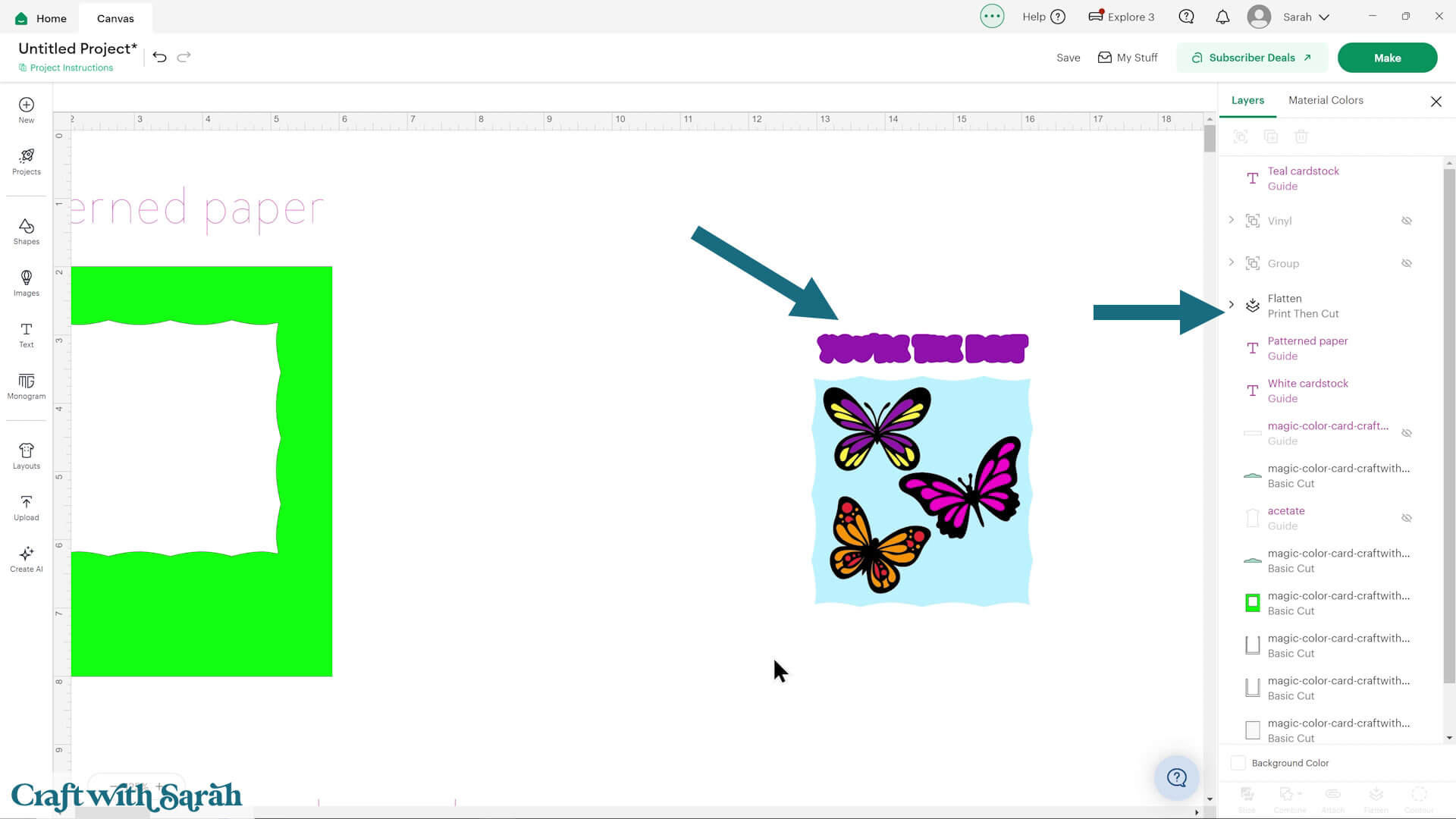
You can make it easier to see by changing the background colour in Design Space.
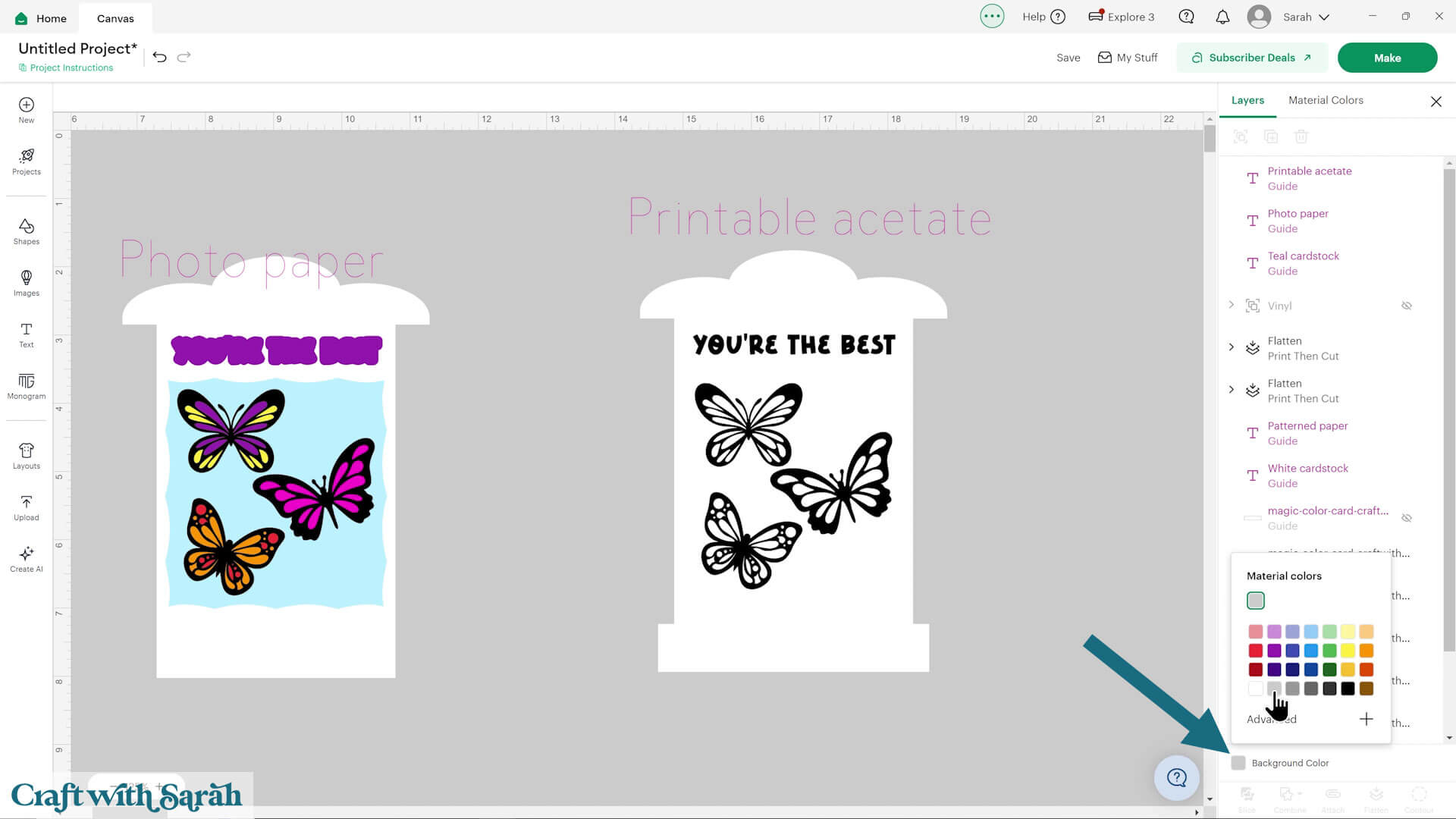
Turn the original blue piece back on, change it to white, and Flatten it to the original black versions of the images.
This will be cut from the printable acetate.
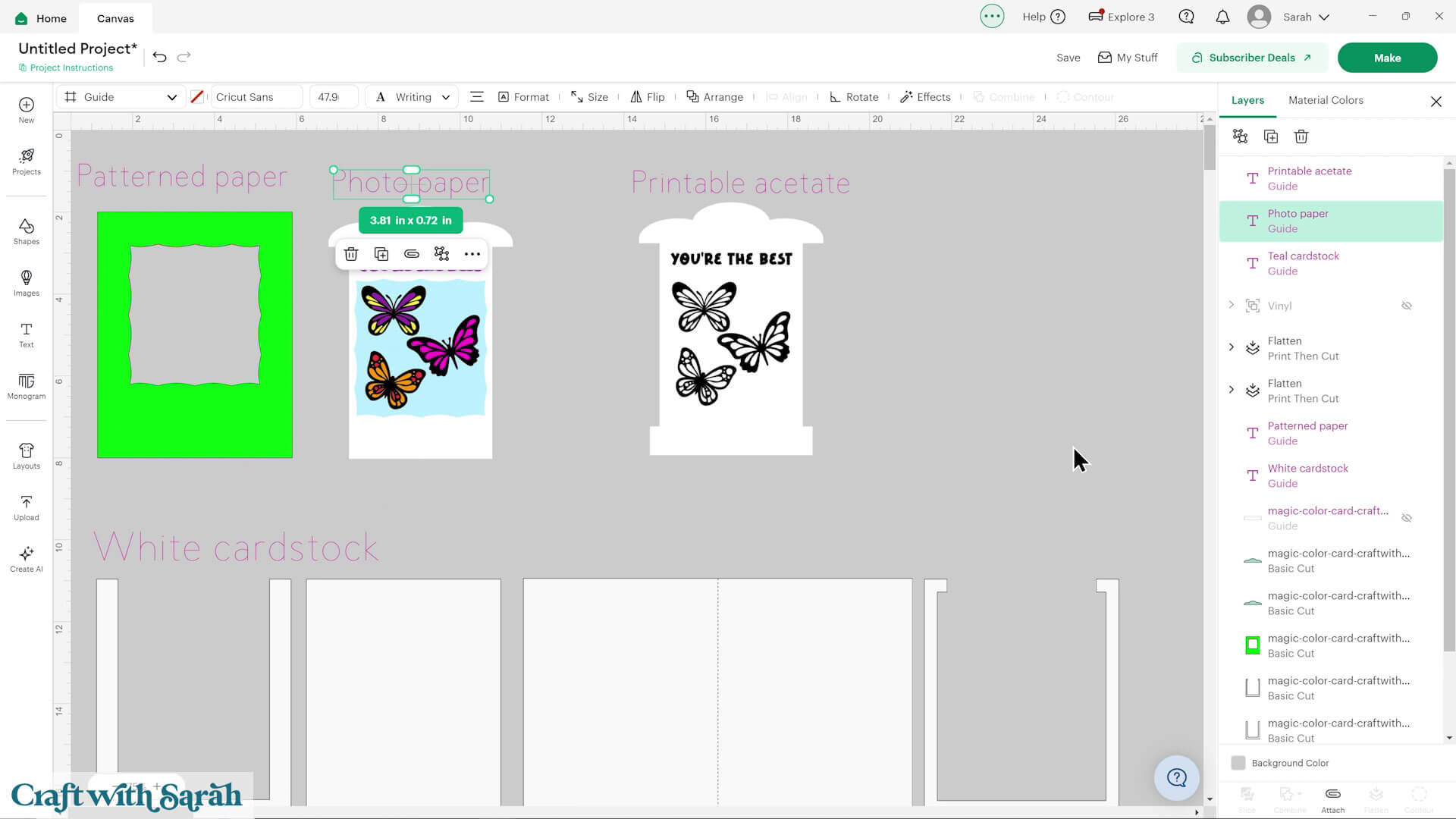
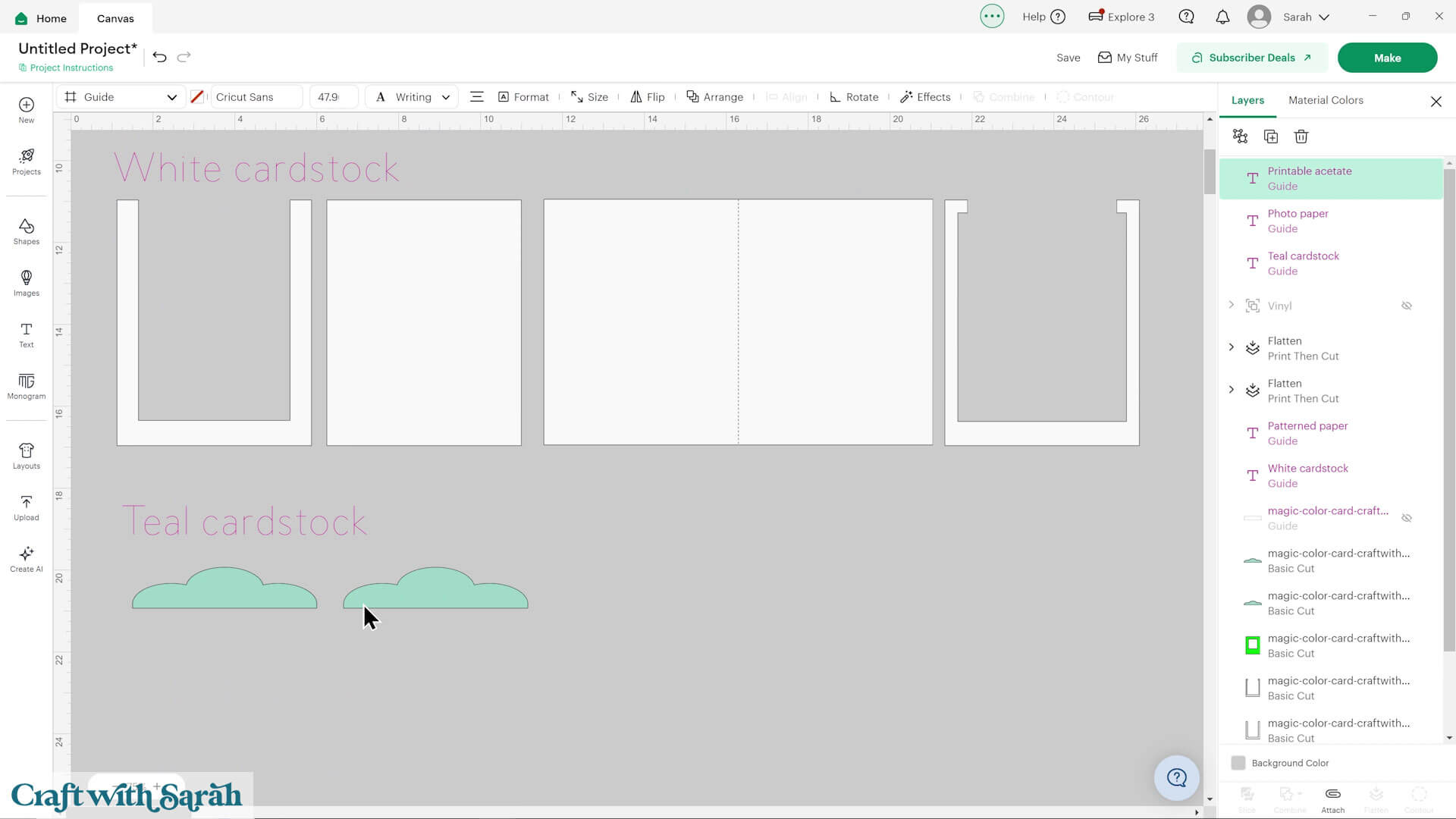
Your project should now look something like this:
ADHESIVE VINYL OR STAMPING VERSION
No printer or printable? No problem!
This version can be done with adhesive vinyl for the pictures, and regular acetate (or the cover off an old Cricut mat).
Move the two tabs that will be cut from cardstock away from the rest of the design.
Change the red pieces to “Guide” layers in the Operations dropdown.
Change the blue layer to a “Guide”. This will be cut from acetate.
Move your pictures over to the main shape, making sure you don’t go outside the guides.
If you’re using rubber stamps for your pictures then you would leave yours blank inside the guides.
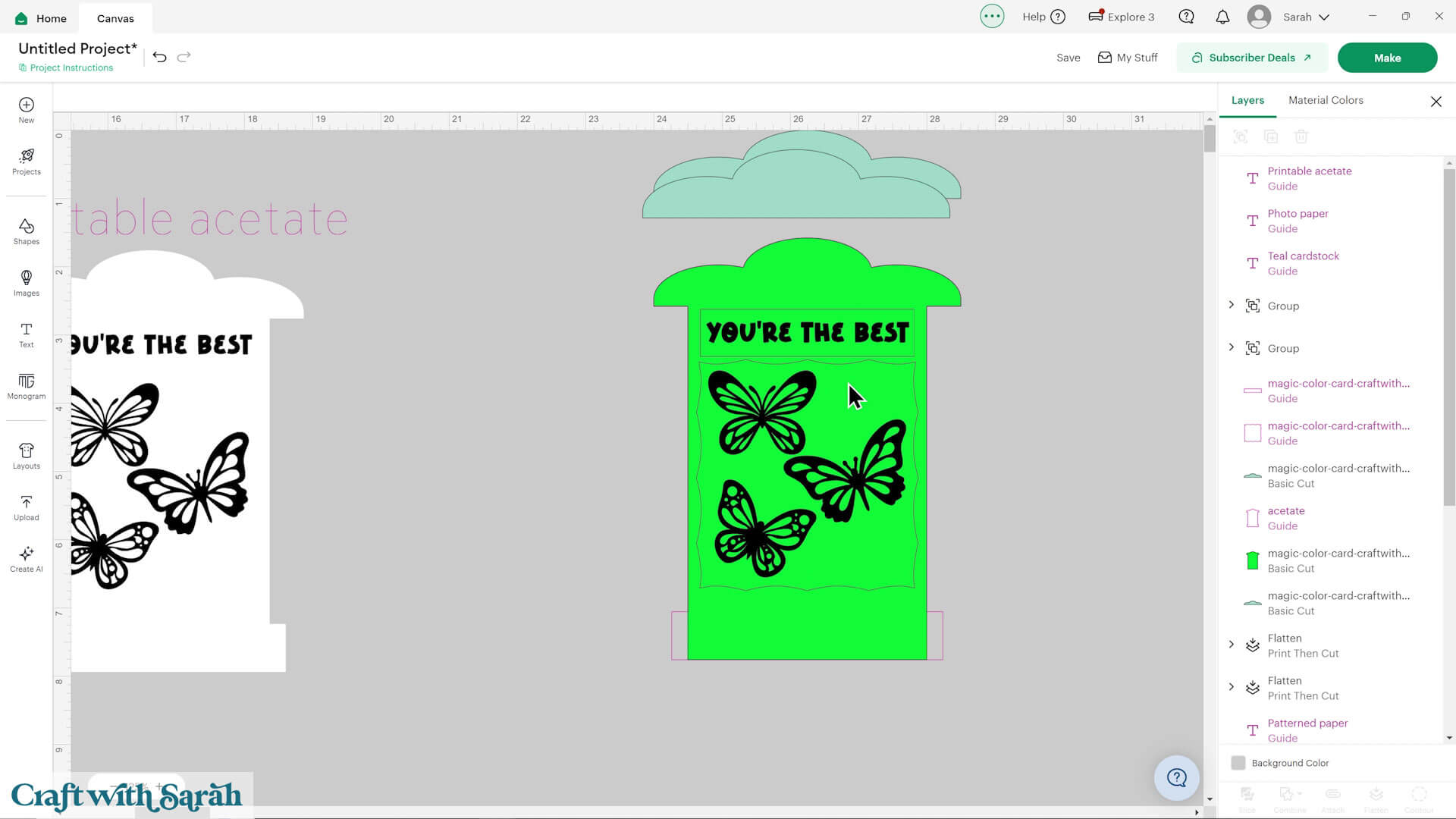
Duplicate the green layer in place by holding your mouse over the group (on the canvas not in the layers panel) pressing Alt (Windows) or Option (Mac) on your keyboard and left-clicking.
Change the colour of the top one.
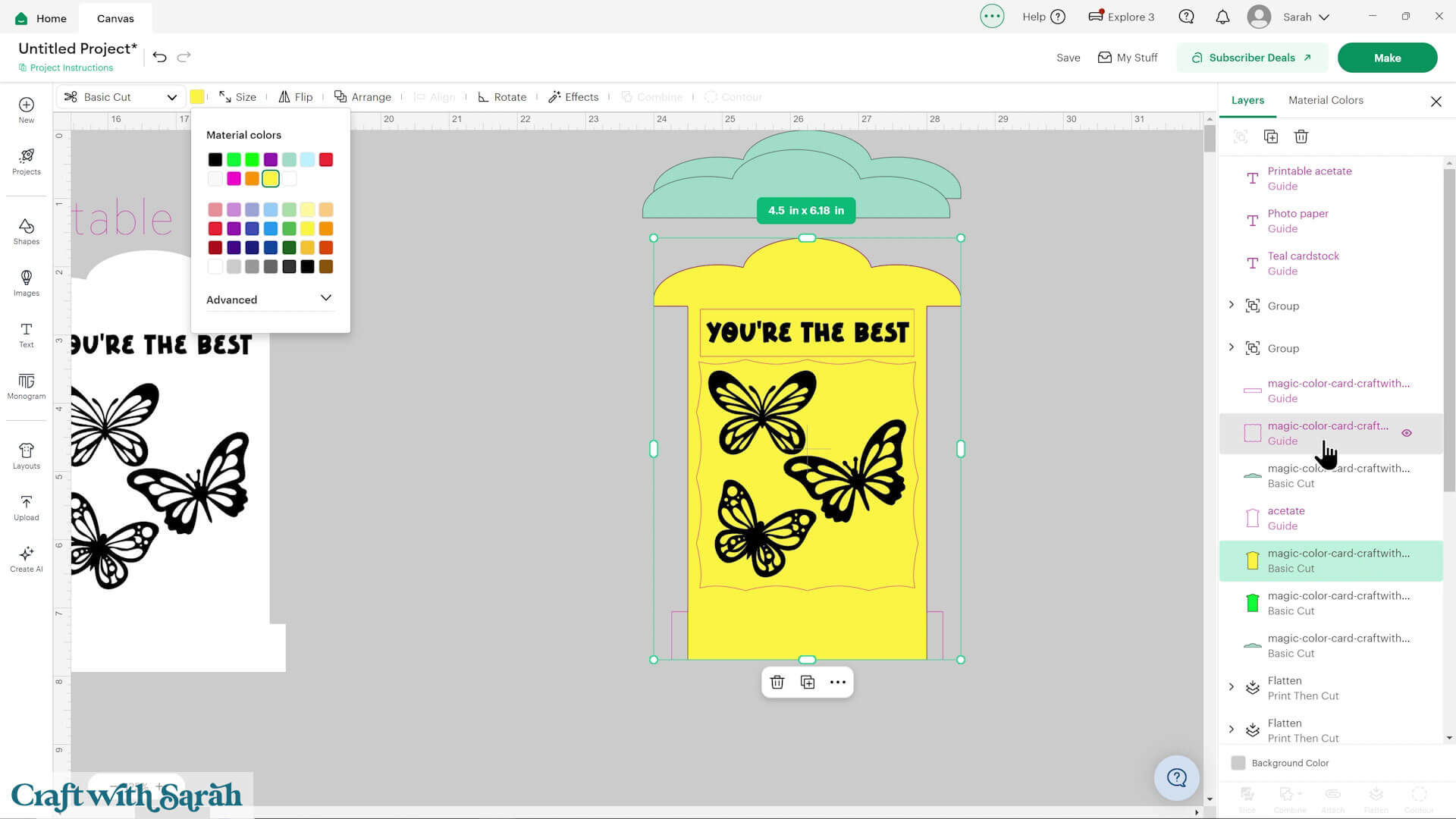
Change the guide outlines back to a “Basic Cut” in the layers panel (they should go back to being red), then select both of them and the copy of the base and press “Combine > Subtract”.
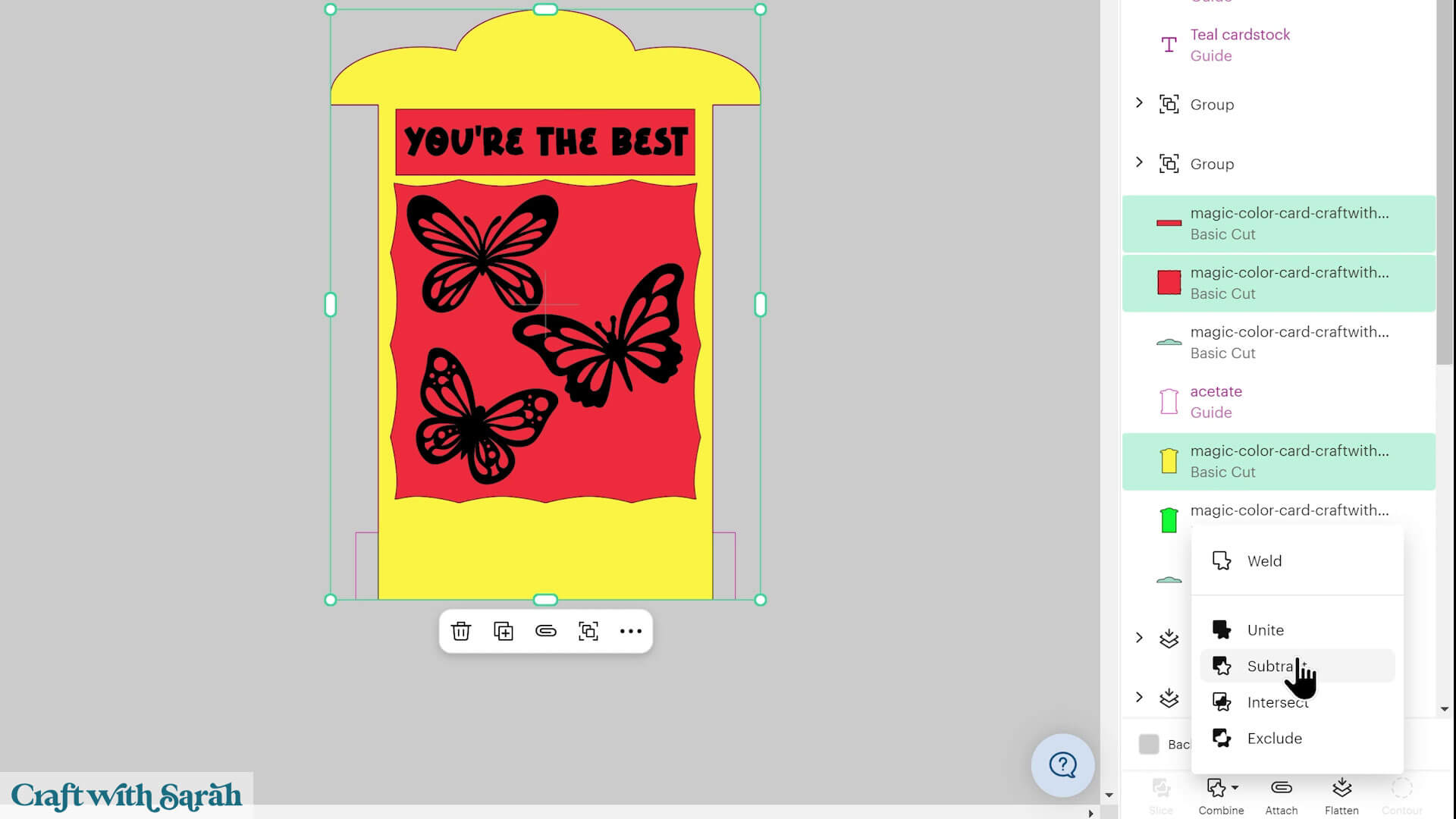
That will cut the red parts out of the yellow.
We’ll use this as a template when putting the card together to know exactly where to place the images.
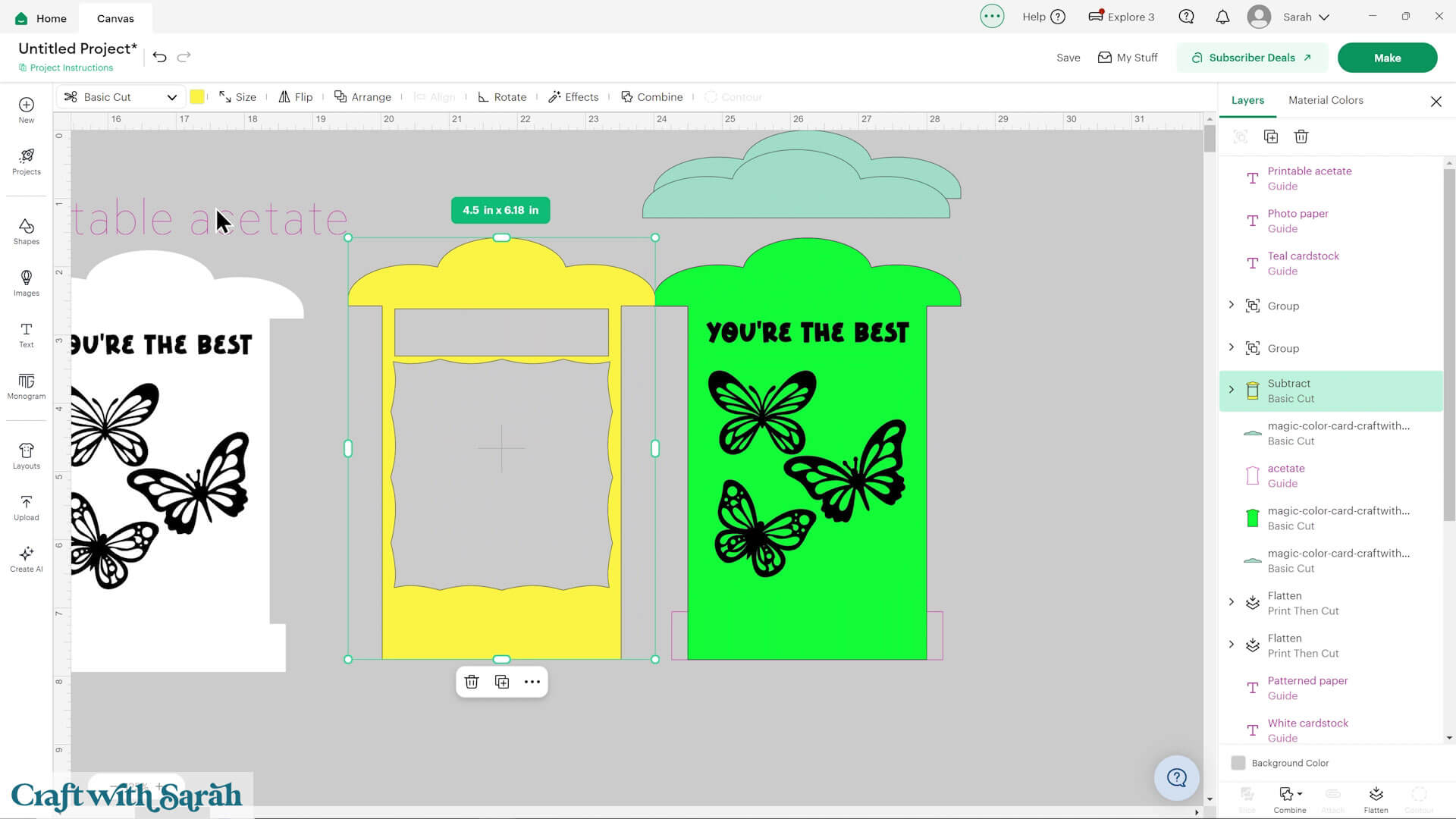
Change it to white and move it down with the other white cardstock pieces to move it out the way.
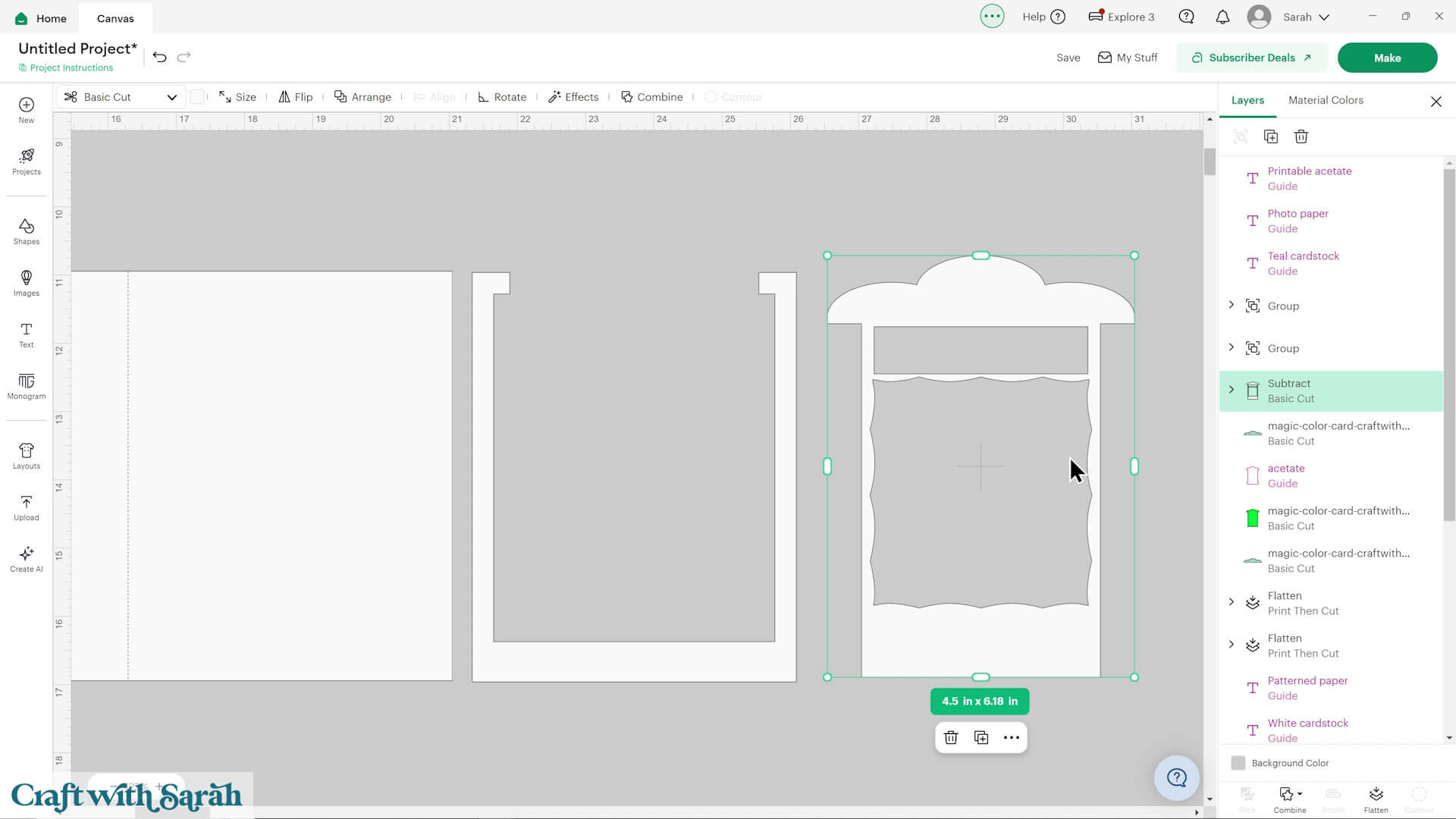
Change the green template layer to white. This will be cut from regular white cardstock to put the vinyl or stamped images on after cutting.
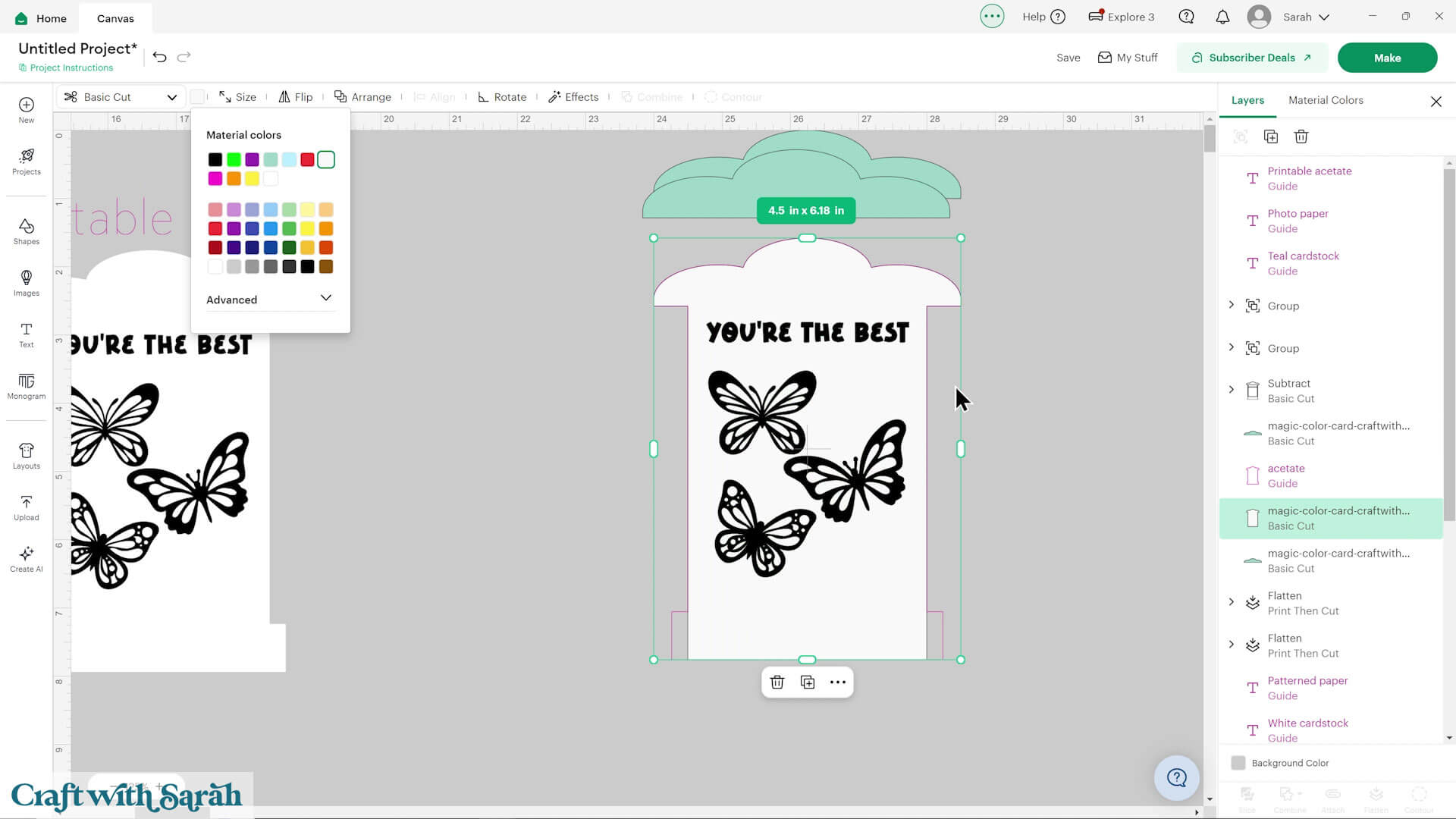
Change the acetate layer to blue.
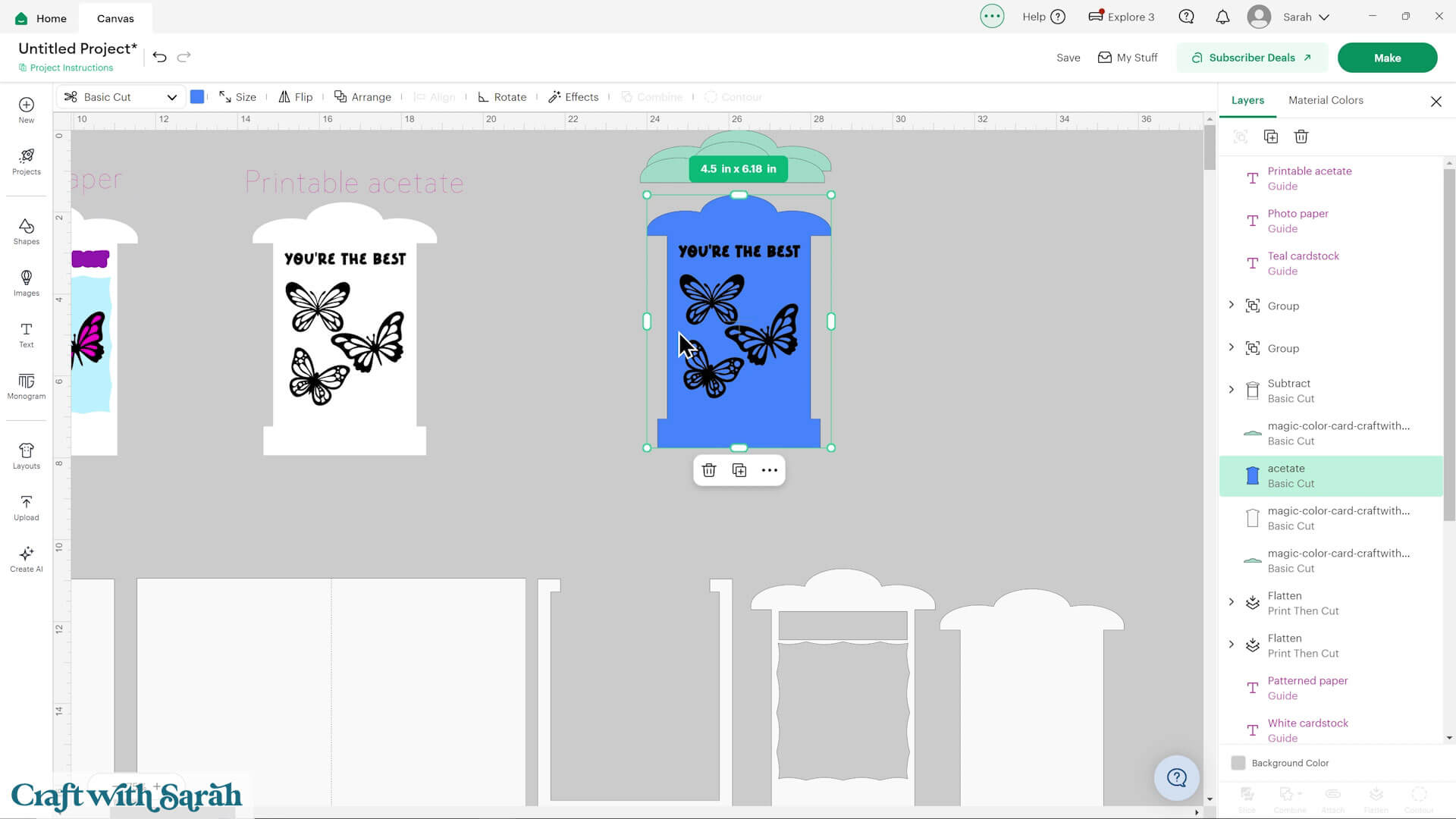
Move the pieces out the way so you can just see your text and images.
Select all of them and “Attach” them together. That joins them together so that they will cut in the same positions relative to each other.
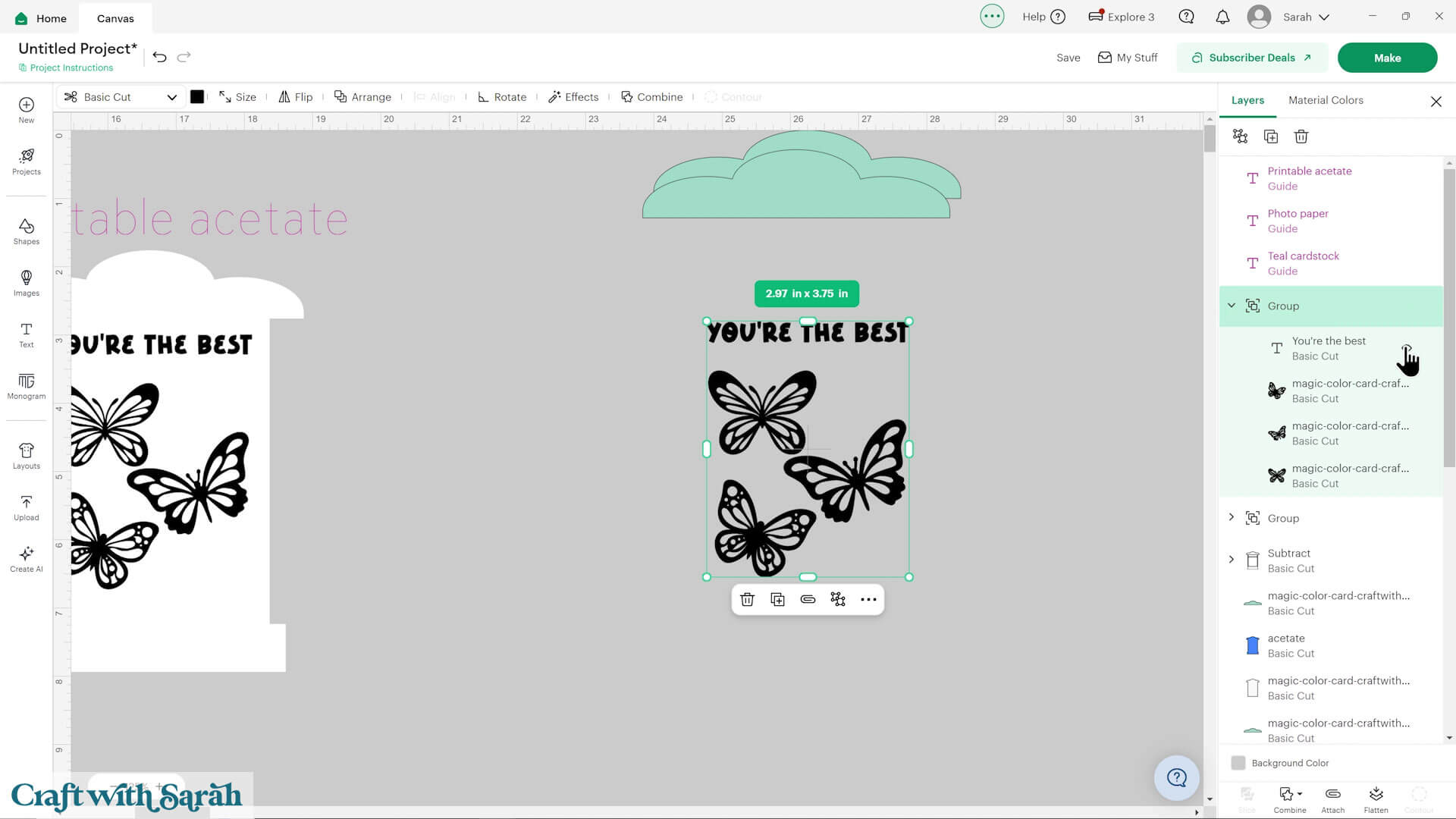
I decided to remove the text layer as I didn’t want to weed out those teeny tiny details. I’ll add a greeting using a peel-off sticker instead.
Duplicate the Attached group of images as you’ll need one to be the “black” images on the front of the card, and one to be coloured in for the inside.
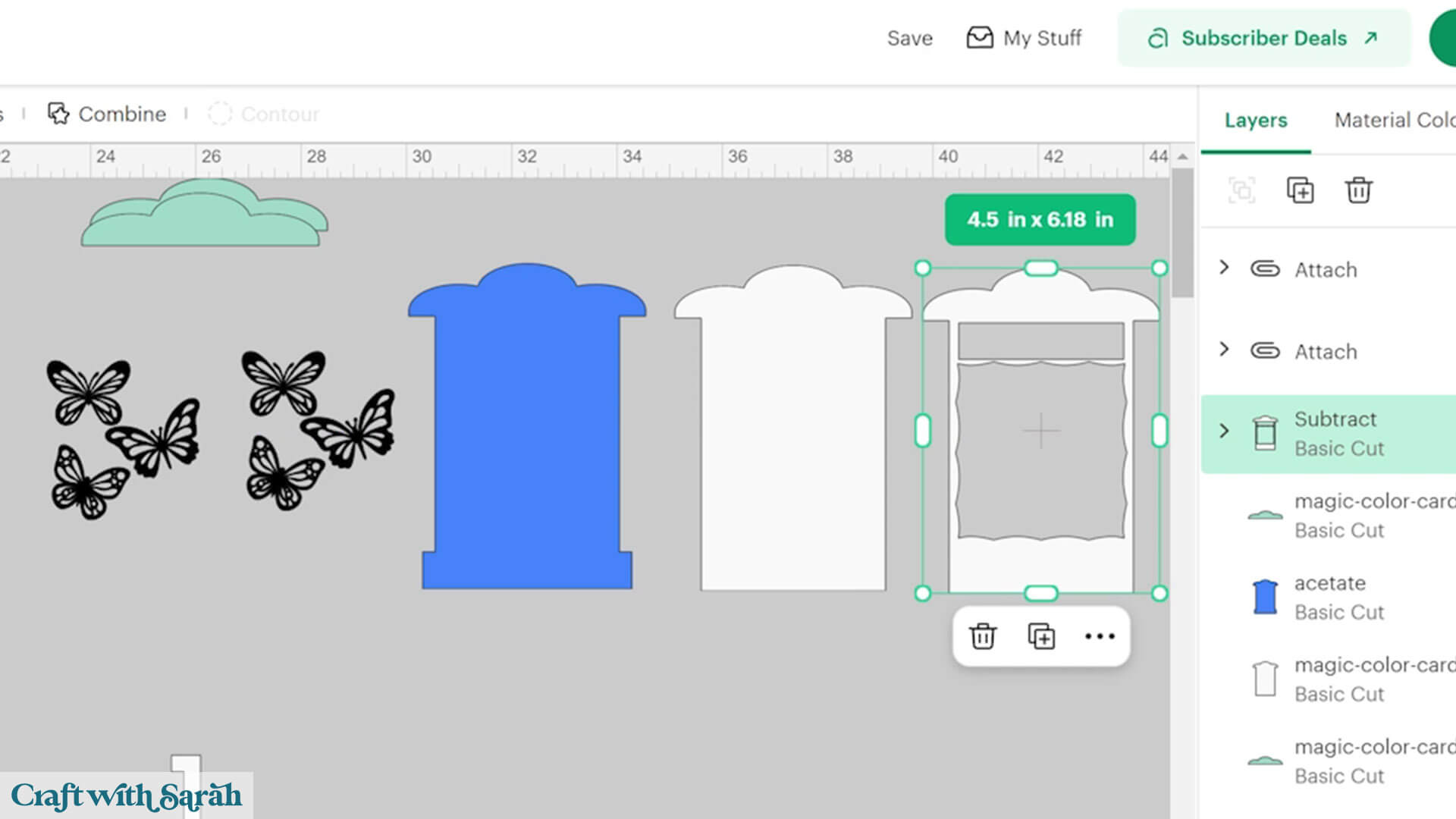
Step 3) Cut the project
When you’re happy with how the project is looking in Design Space, click “Make” and follow the instructions on-screen to cut out all the pieces.
To change the paper size, go into the dropdowns over on the left side of the screen and choose the paper size that you want to use. You need to change it for every single colour.
To save space on your cardstock, you can move things around by clicking and dragging. Make sure when you’re moving things about that nothing overlaps because otherwise, it won’t cut out properly.
However, be careful NOT to rotate any patterned paper pieces, otherwise they will not cut with the pattern the correct way up when you put the card together.
TIP: New to using cardstock with your cutting machine? Check out these machine help guides for Cricut, Silhouette and ScanNCut that go through every step of the process, including tips for getting the best quality cuts from your machine.
Step 4) Build the card
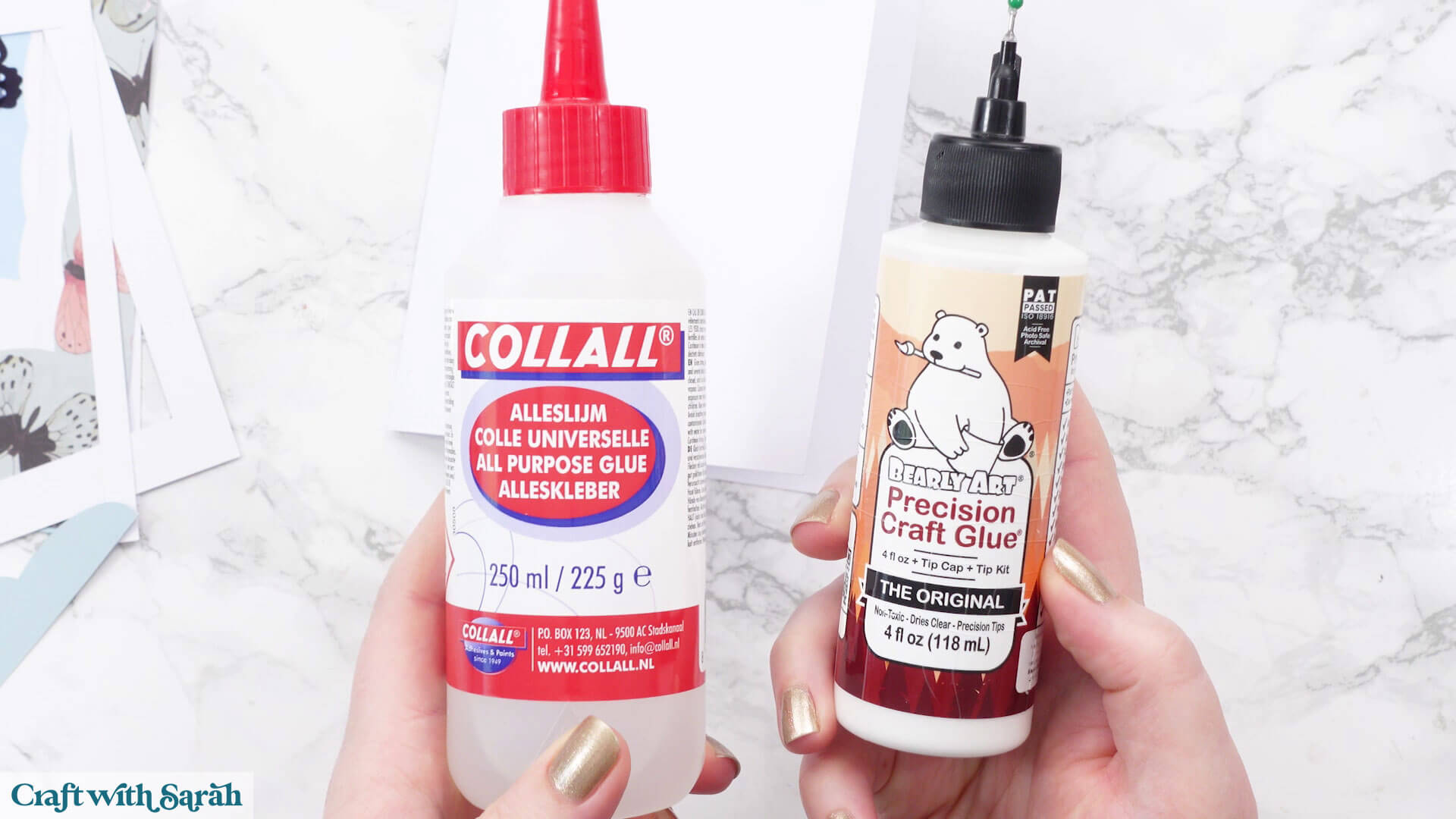
My favourite glues to use on papercraft projects are Bearly Art Glue and Collall All Purpose Glue.
These are great because they don’t “warp” or bend the cardstock like some glues do. You can use as much of it as you want and the card stays perfect – and it dries perfectly clear too!
Bearly Art Glue comes with a tiny nozzle to make it easy to apply glue to small areas of card. The Collall glue doesn’t come with this, so it’s easiest to decant it into needle tip applicator bottles so that you have more control.
You’ll probably find that the printable acetate has a “milky” colour and isn’t 100% transparent. That is ok and won’t make a difference.
If you’re making the adhesive vinyl version then weed out your vinyl to leave only the parts that will be transferred to the card.
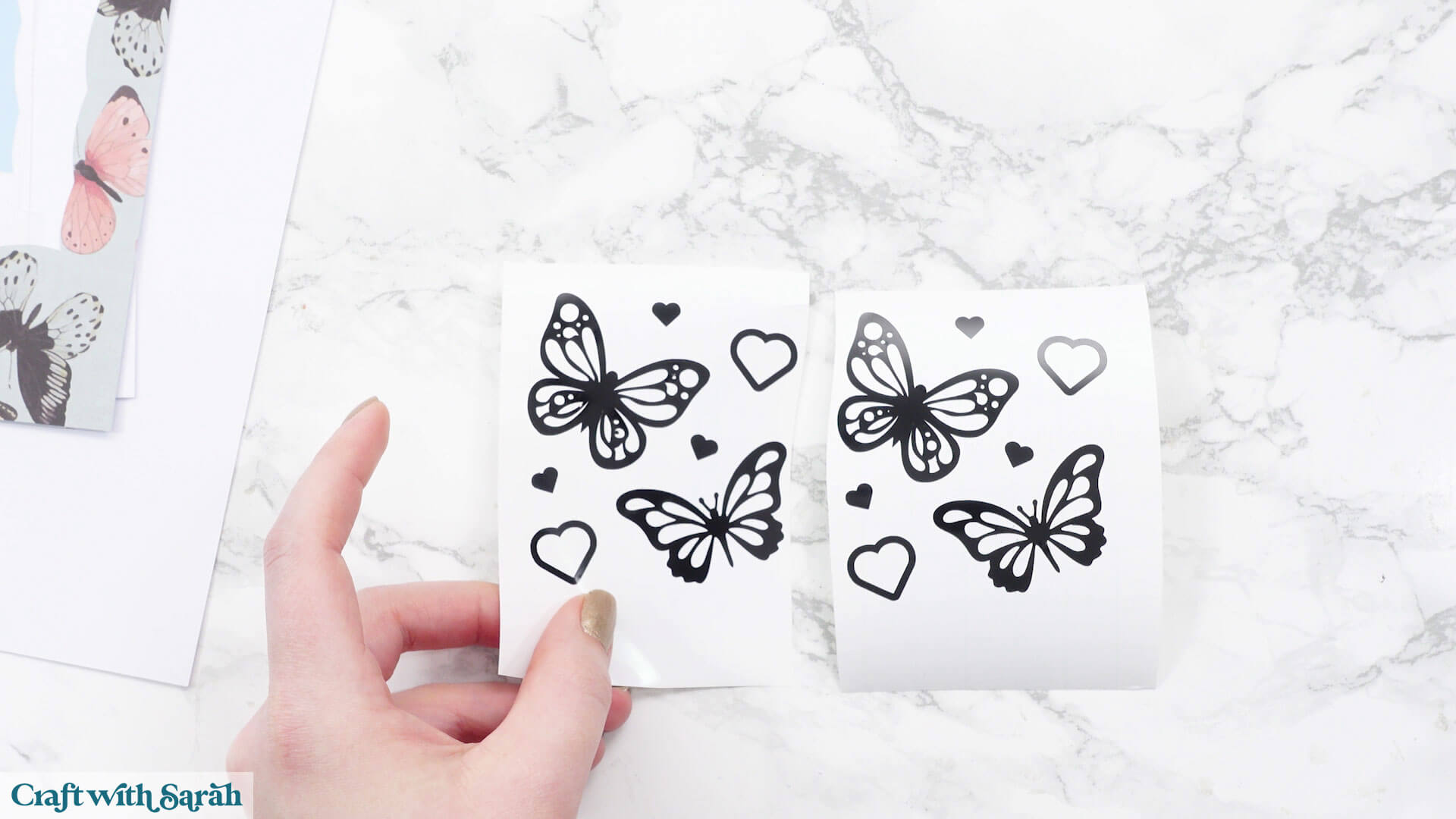
If you’re using the adhesive vinyl or stamping version, place the guide that we created in Design Space over the back part of the card and transfer/stamp your images.
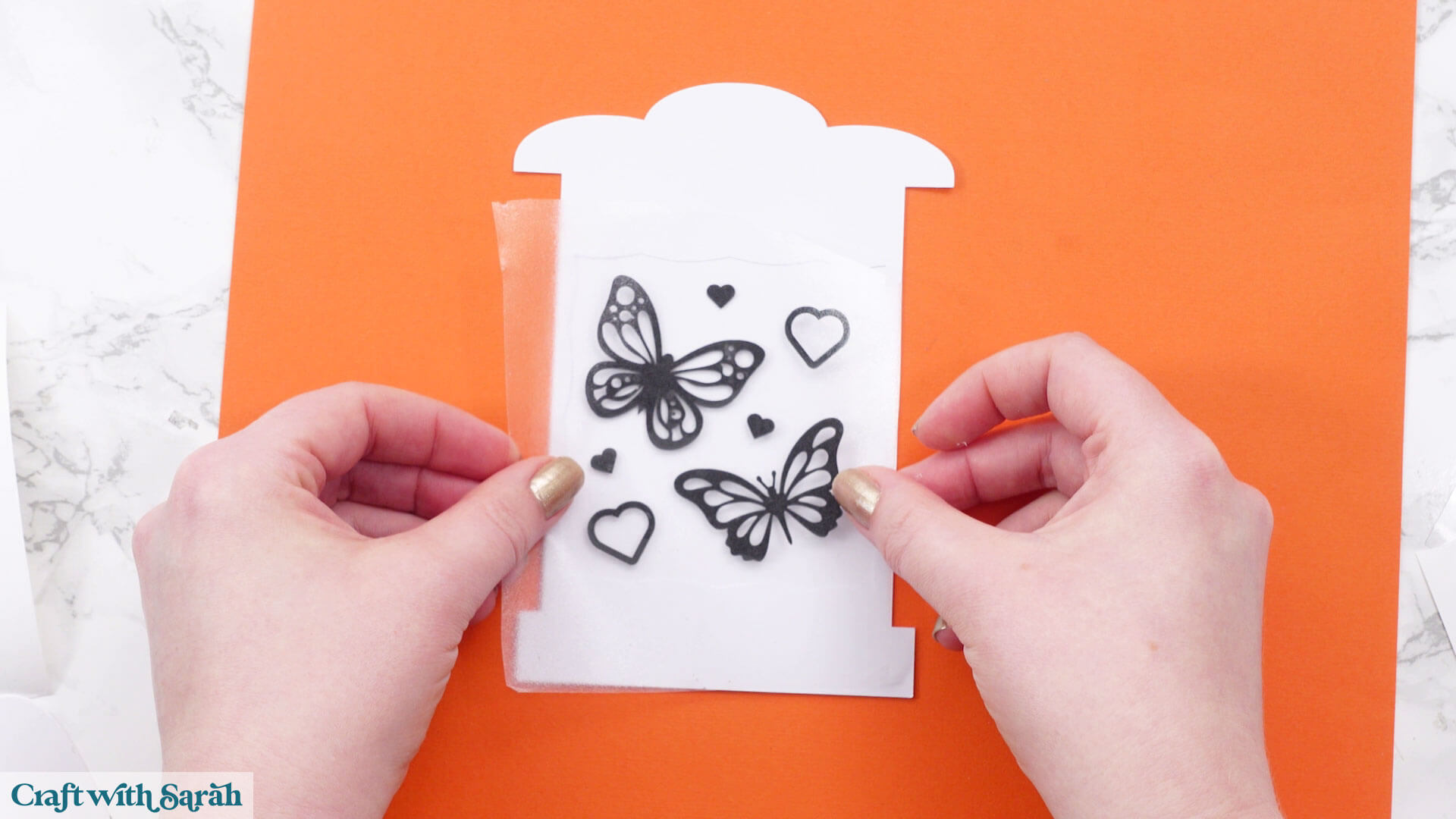
Place the acetate on top, lining up the images.
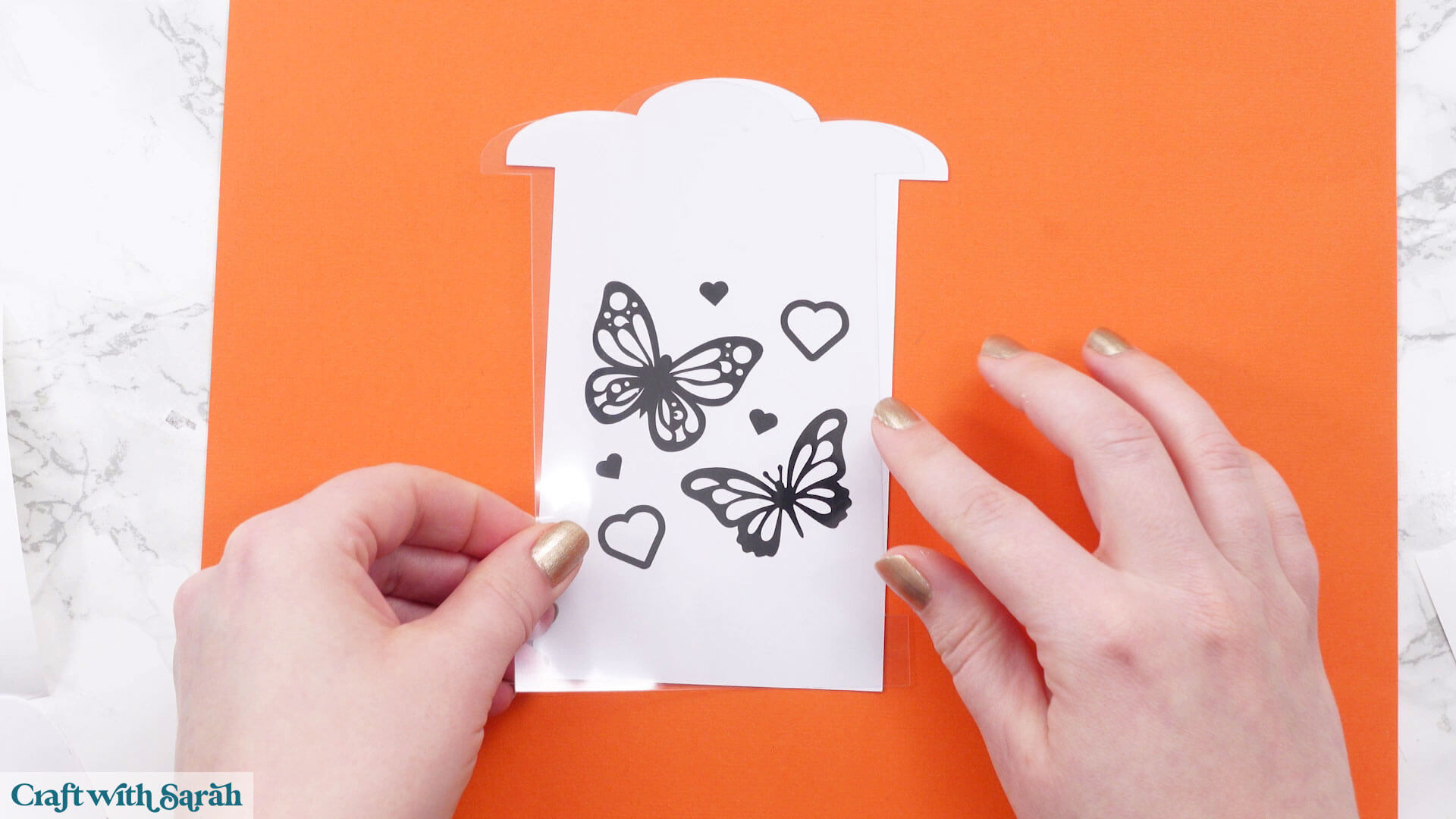
Transfer/stamp the second version of the images so that they line up EXACTLY.
Add glue to the top of the part of the card that will have the coloured images on.
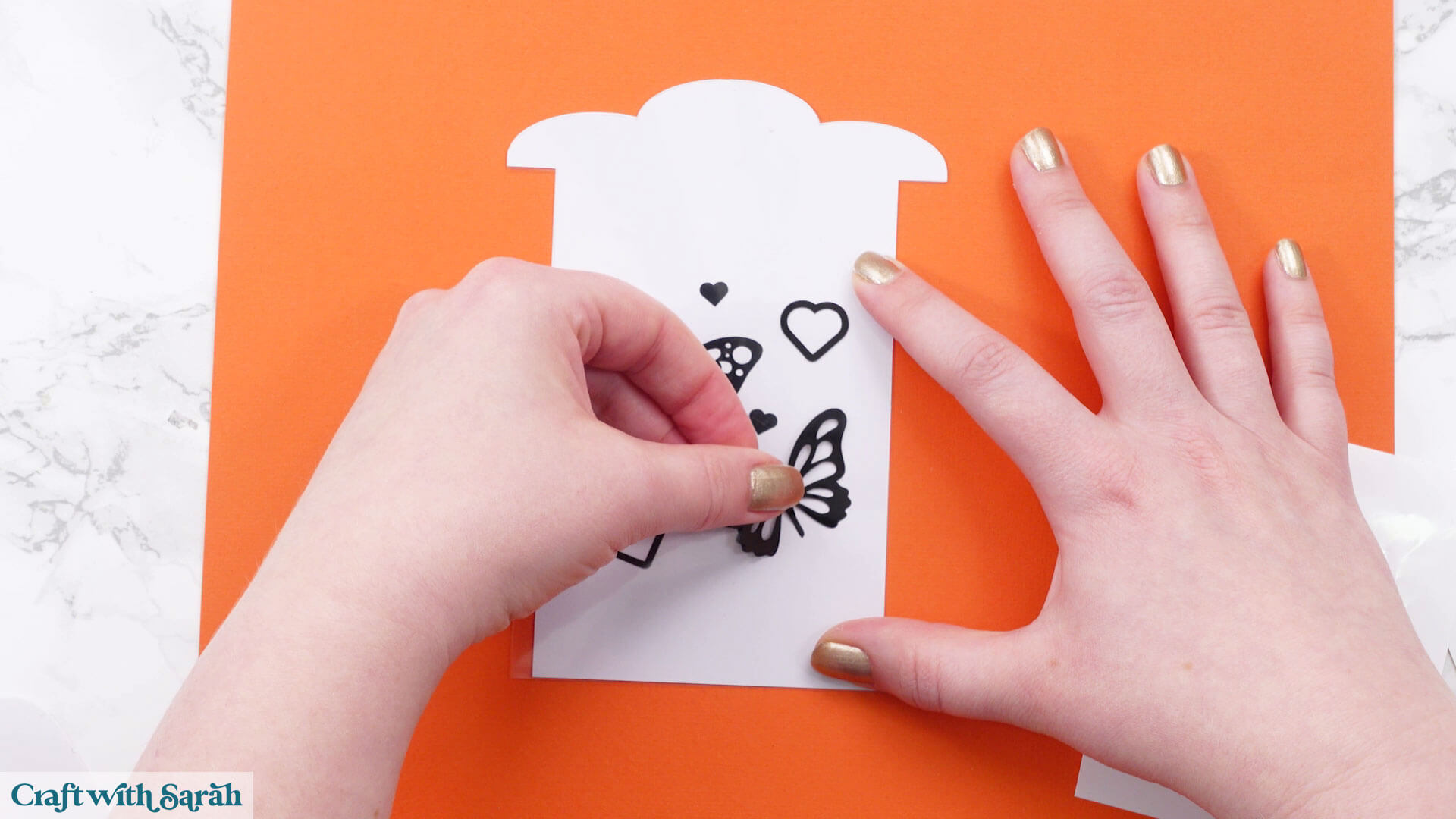
Colour in the vinyl or stamped images on the white cardstock.
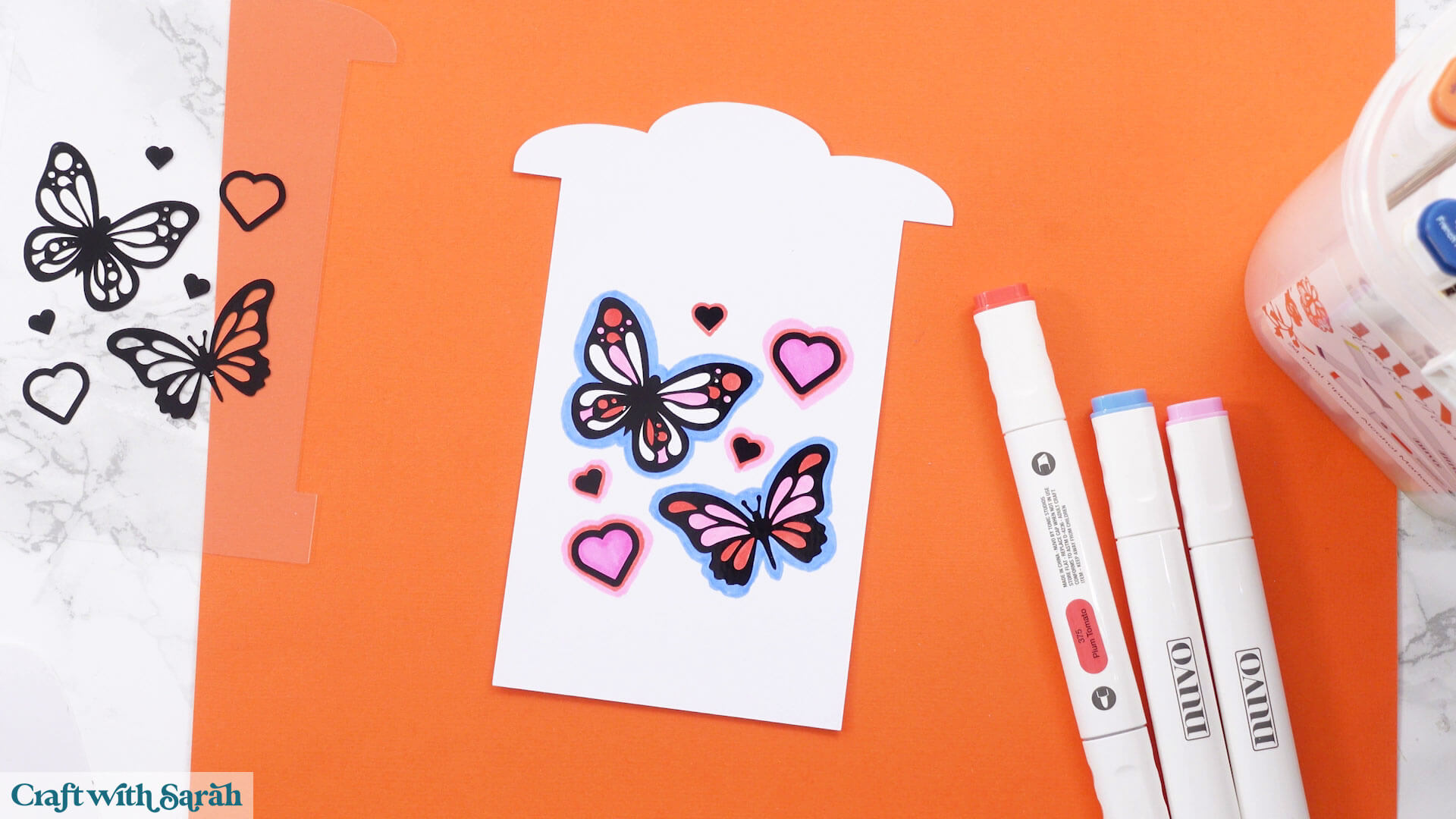
From this point onwards, the steps are the same for both the printed version and the stamped/vinyl version of the card.
I’ll show the printed version in the images below.
Add glue to the top tab shape of the piece with your coloured images on.
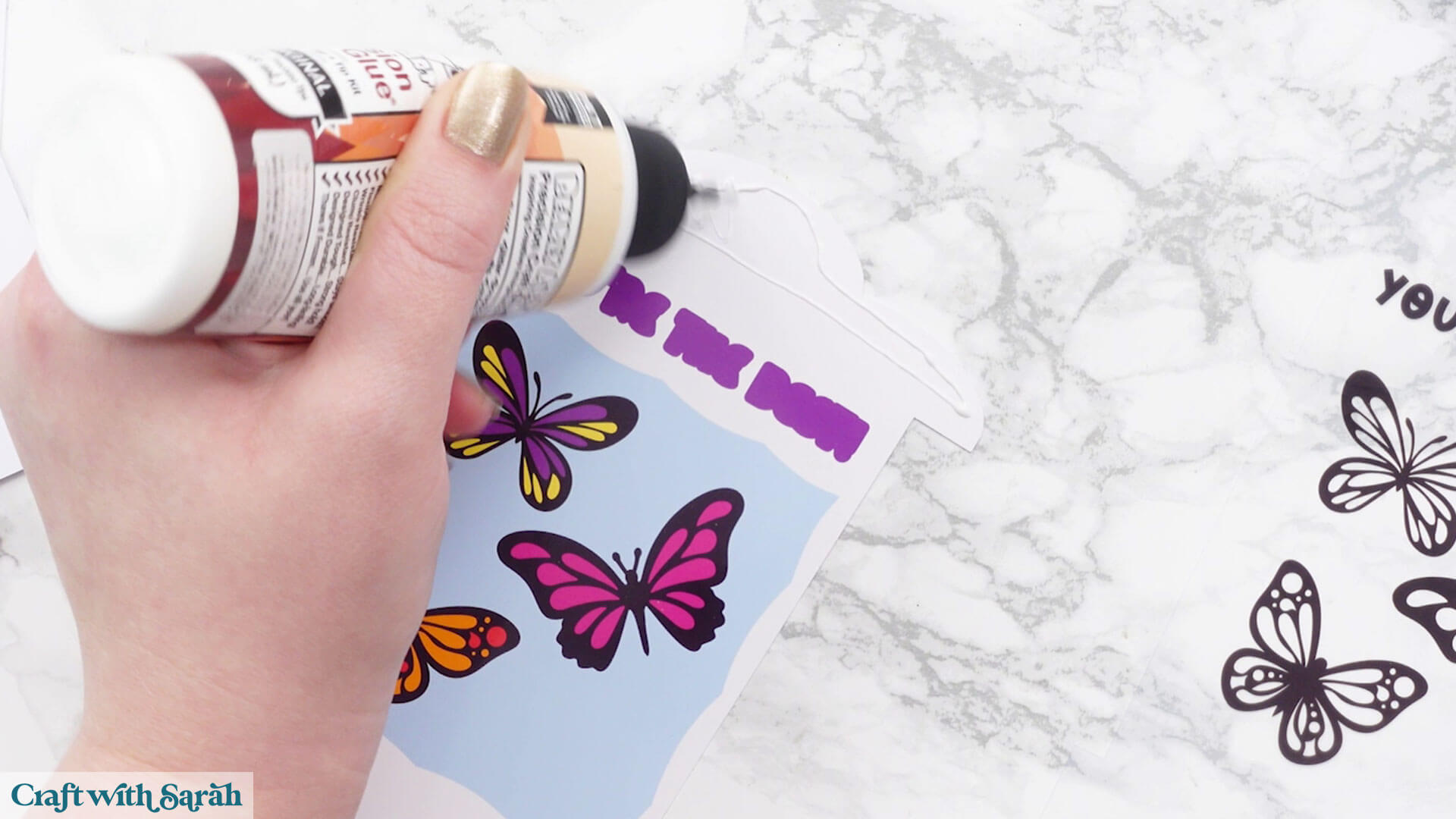
Stick the acetate shape on top, lining up the pictures.
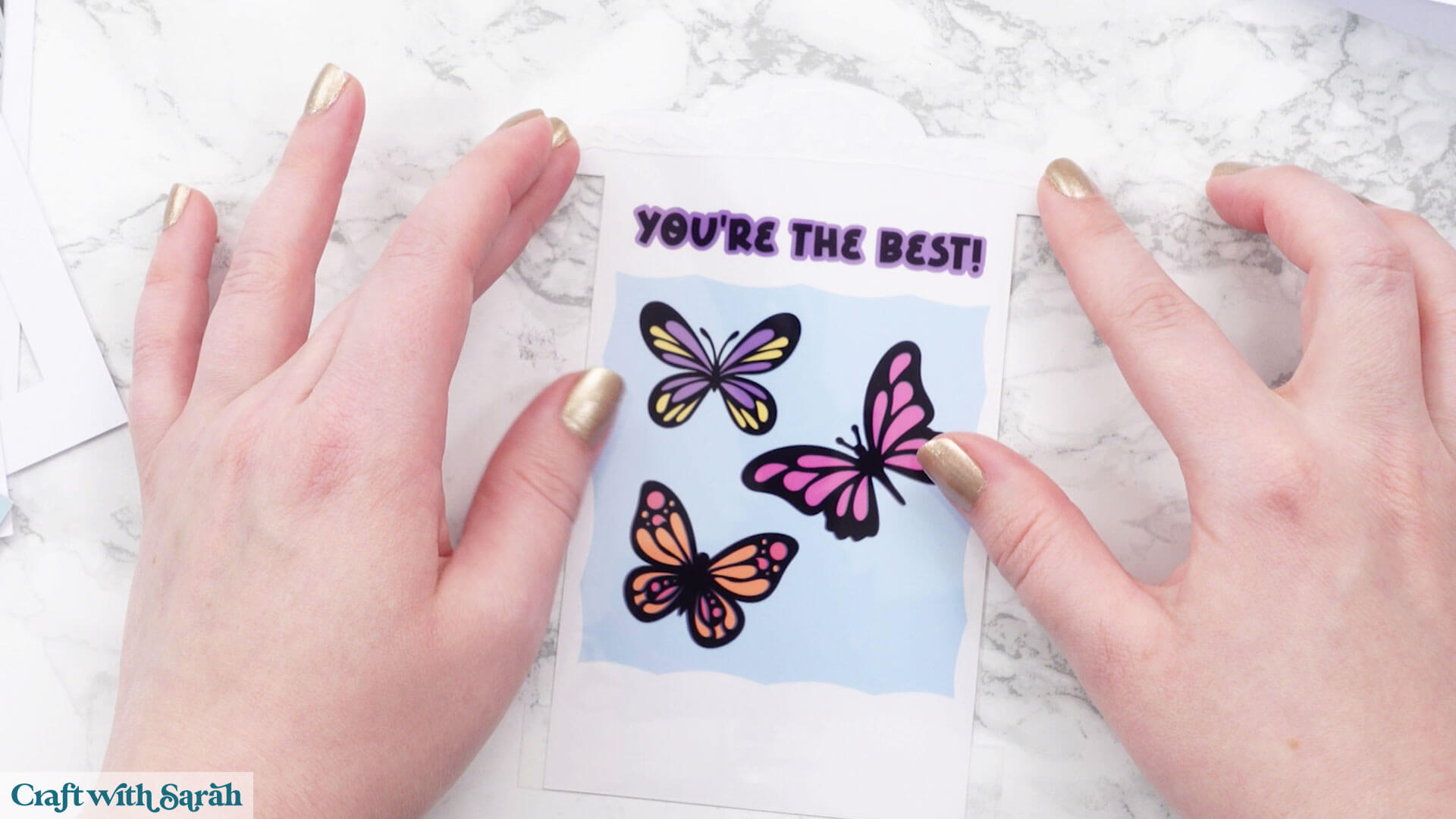
Glue the coloured cardstock tabs on the front and back.
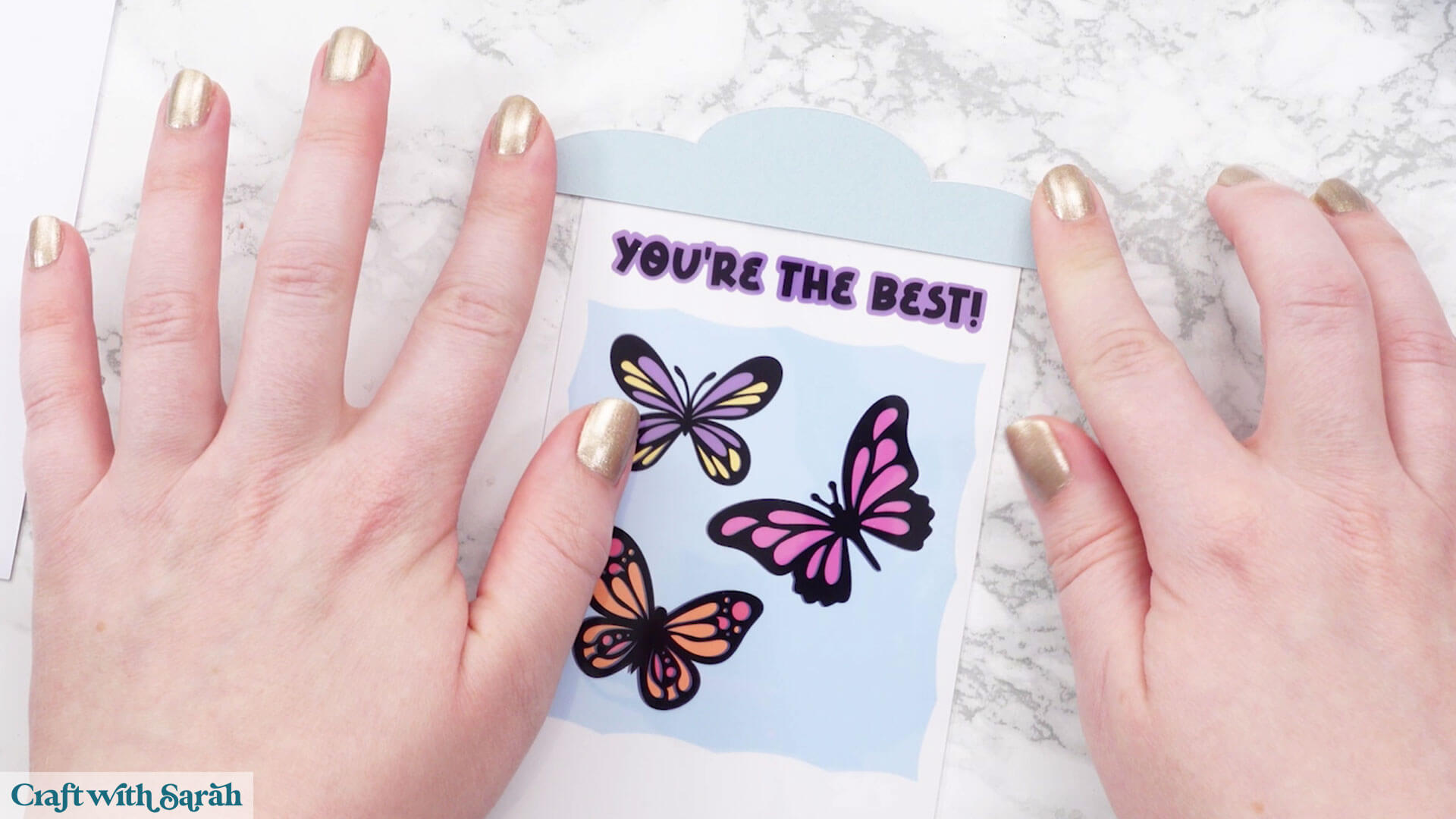
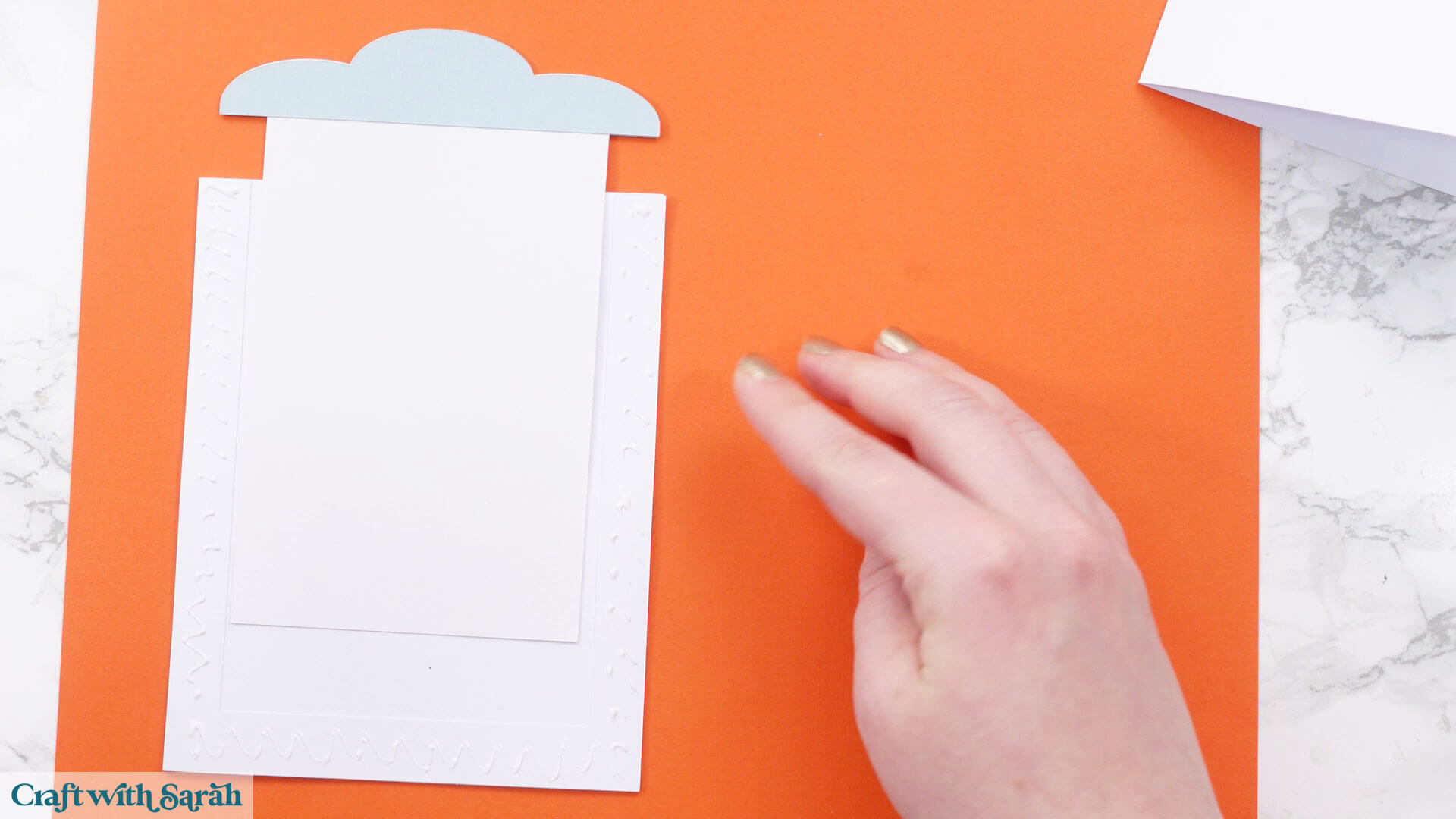
Take the solid rectangle and the outline shape that you only have one of on top.
Yours will be in white, but I have highlighted mine in grey below to make it easier to see.
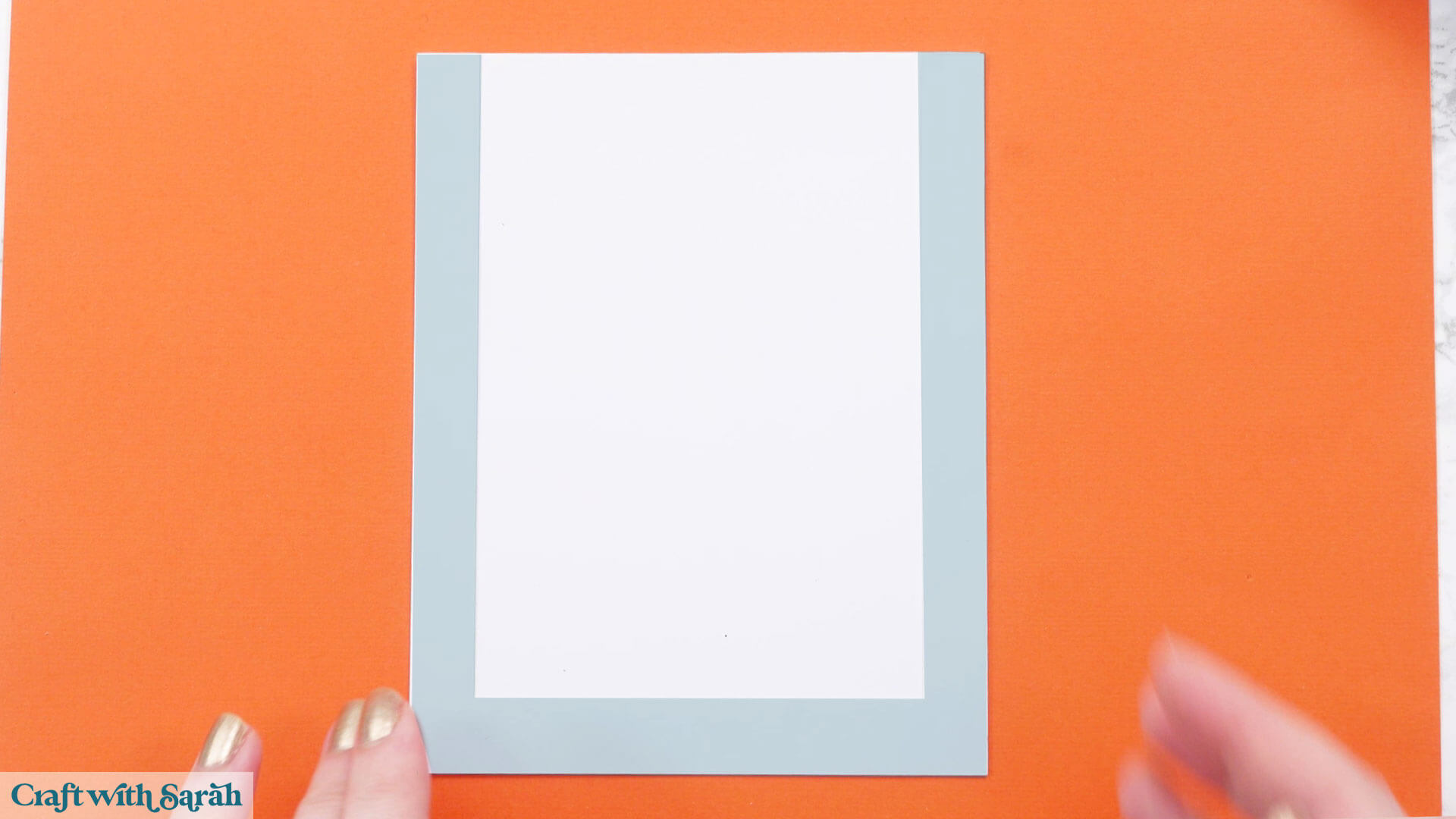
Turn the card over and glue the outlines WITH the tab lines at the top to the other side. You will have two of these pieces that look exactly the same. Glue them one-on-top of the other to double up the height. This gives the acetate more room to move about.
Yours will be in white, but I have highlighted mine in grey below to make it easier to see.
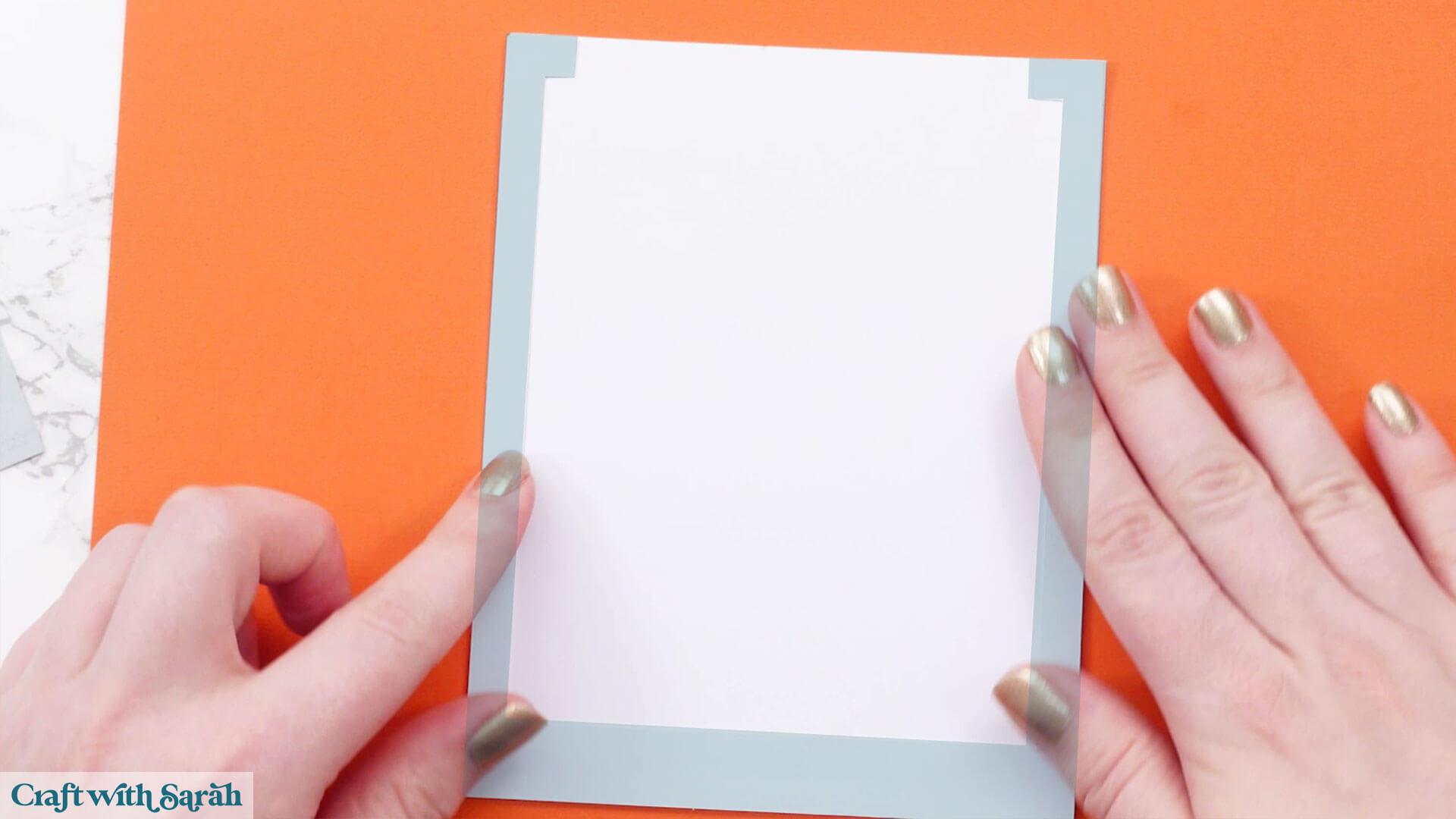
Split the white cardstock and acetate pieces.
Slide the acetate over the top of the piece you have just glued. The coloured part will sit behind.
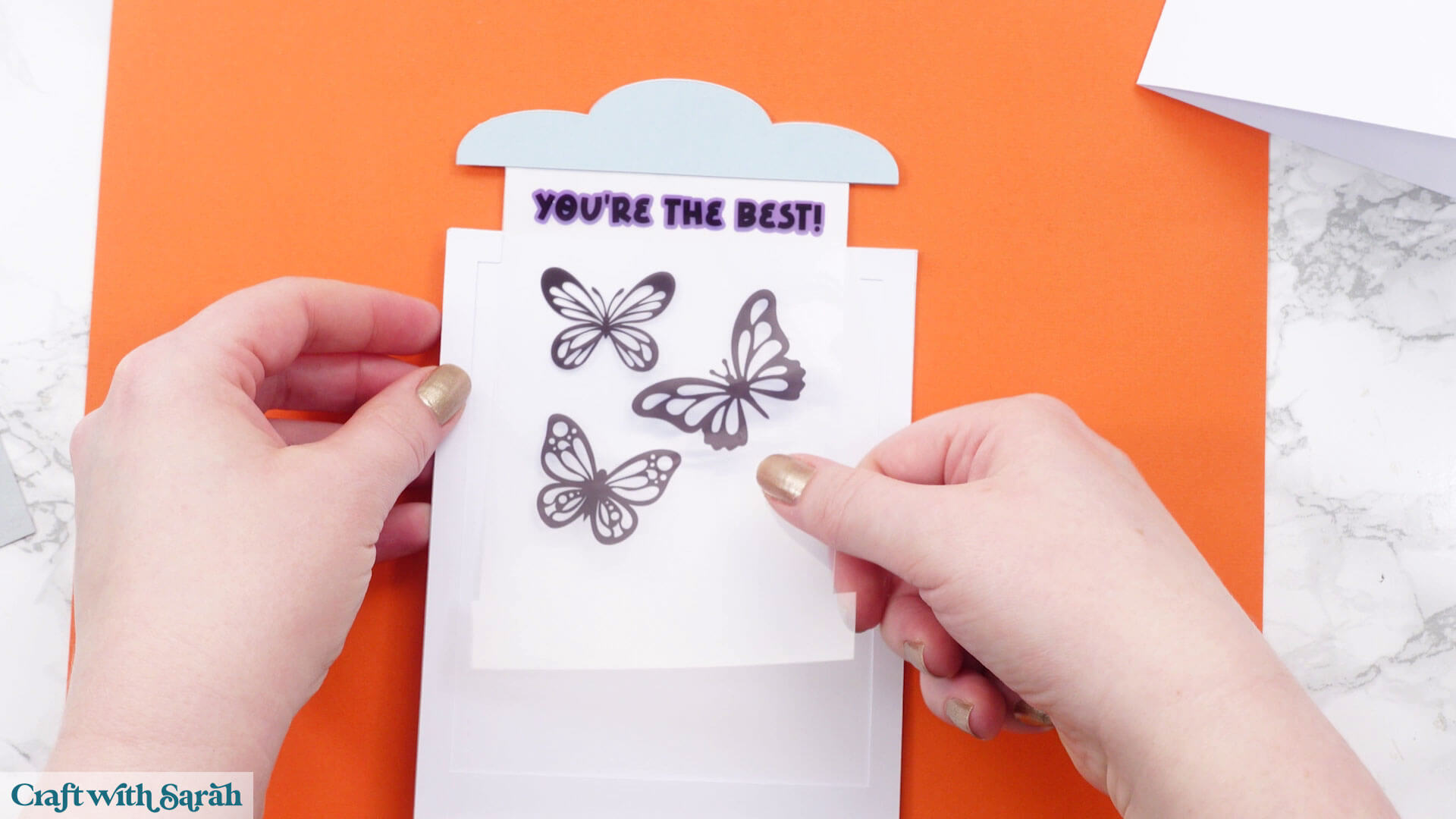
Add glue to the outline piece.
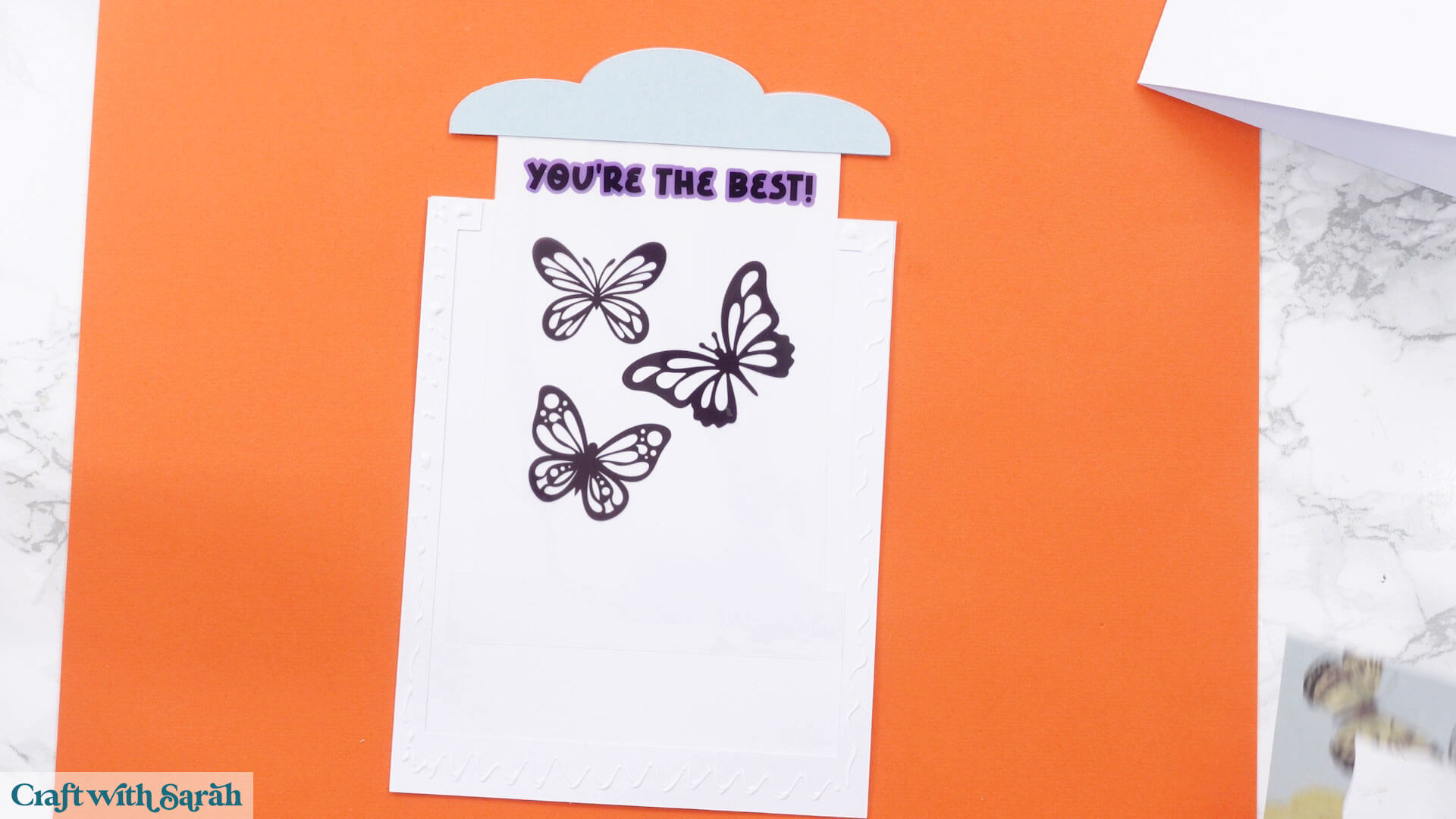
Glue the front of the card on top.
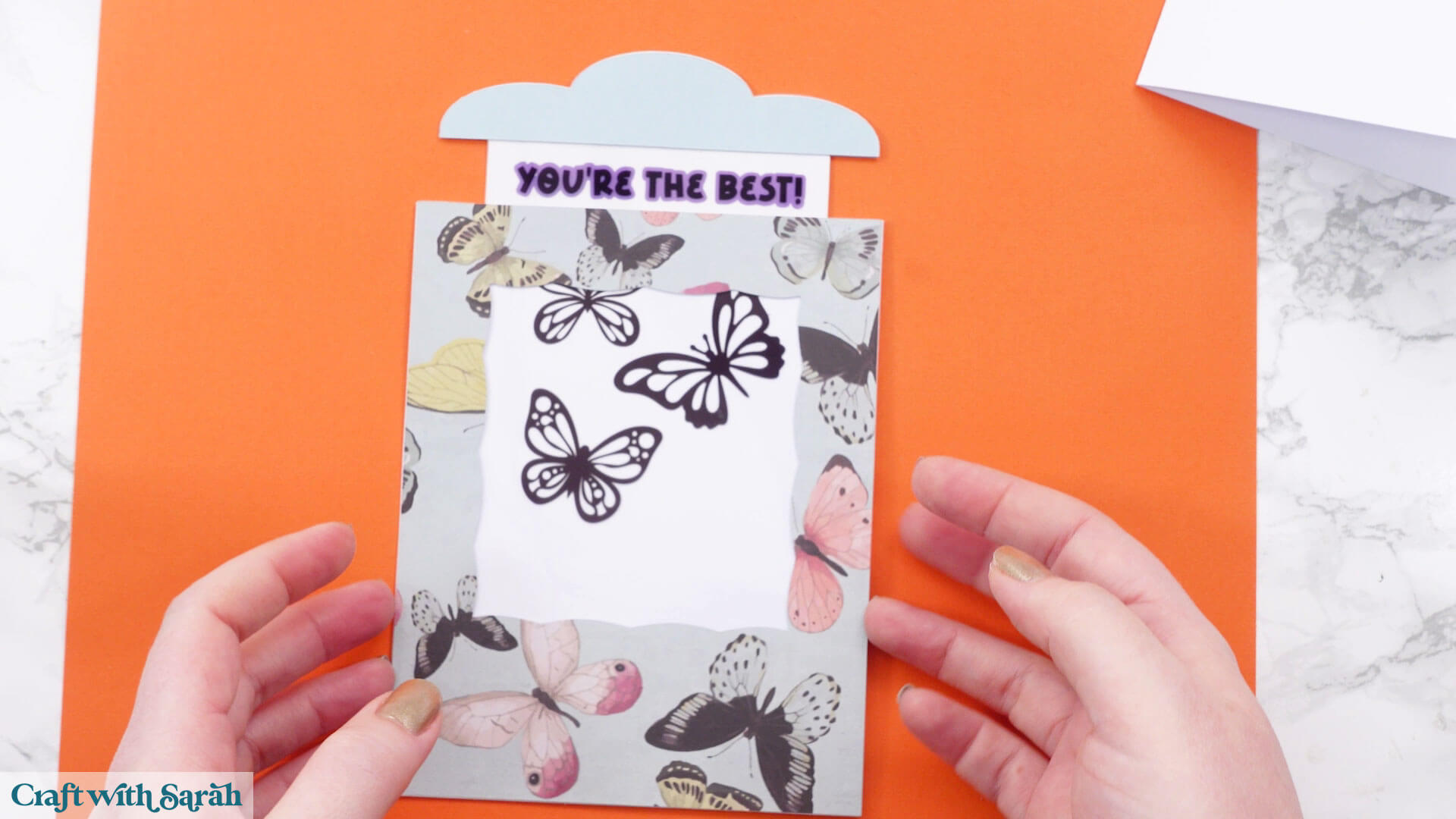
Turn it upside down and add glue down the outline piece.
Fold the base card in half down the score line, then stick the magic colour mechanism to the front.
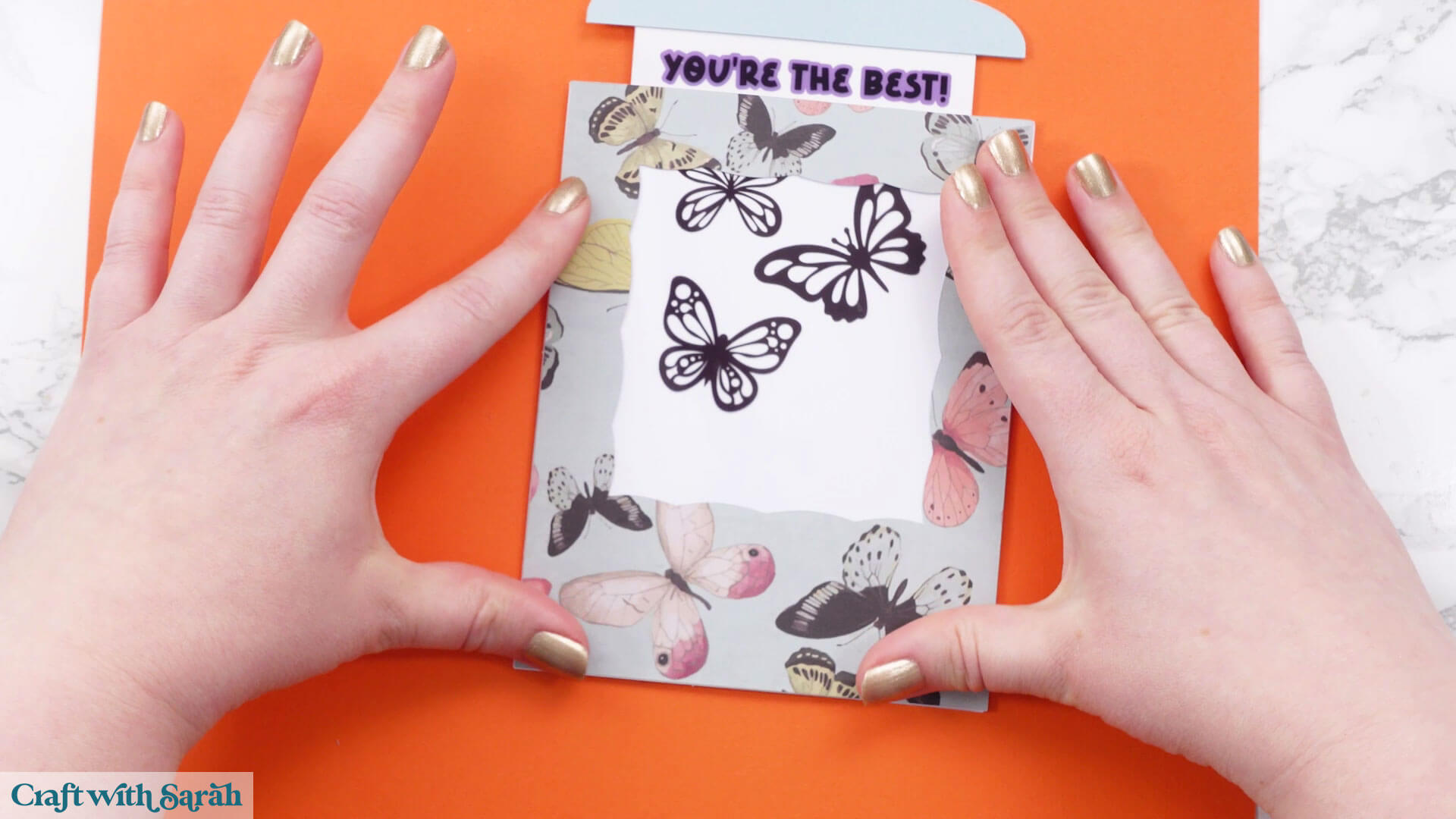
Wait for the glue to dry before you give it a try.
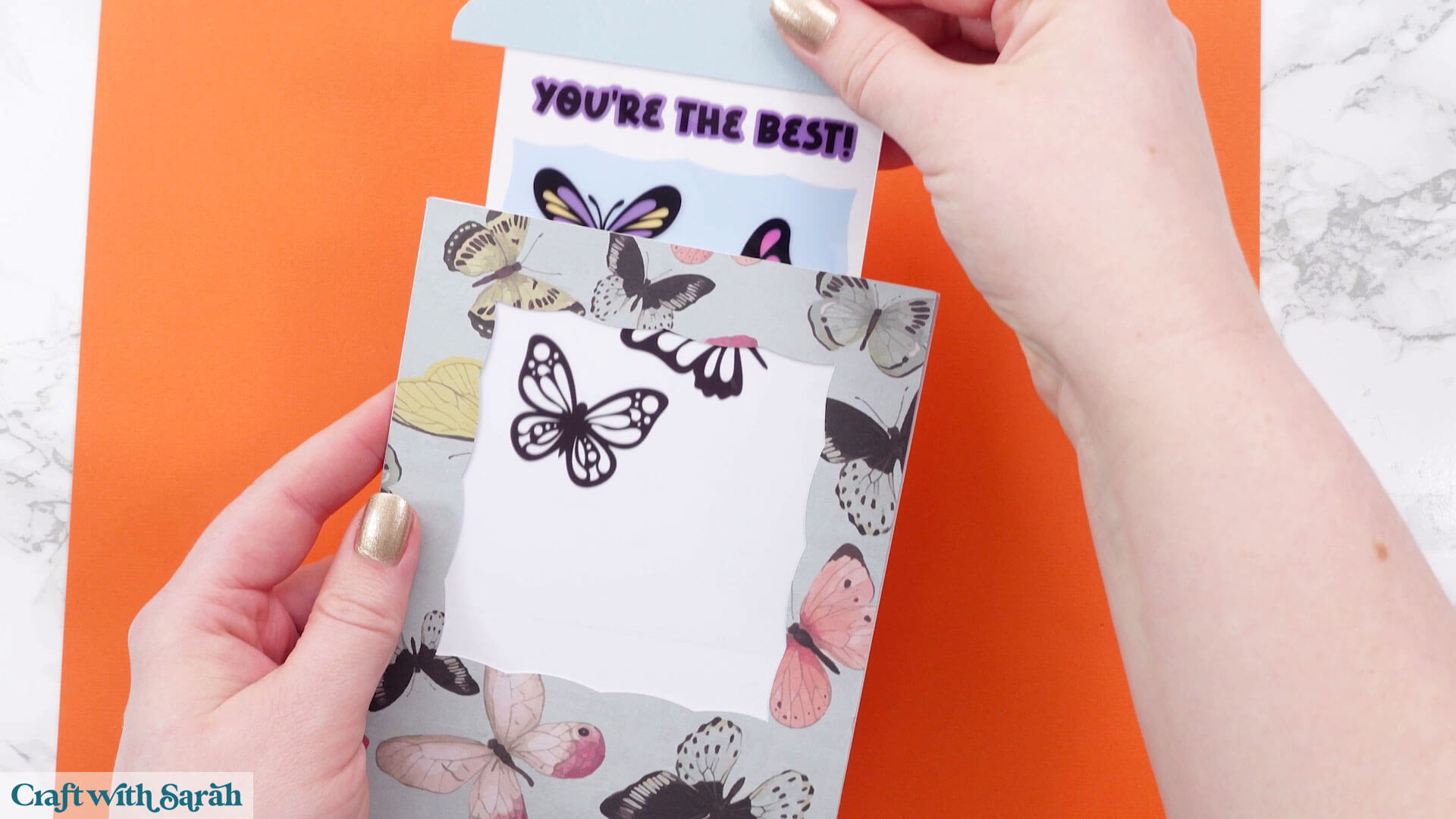
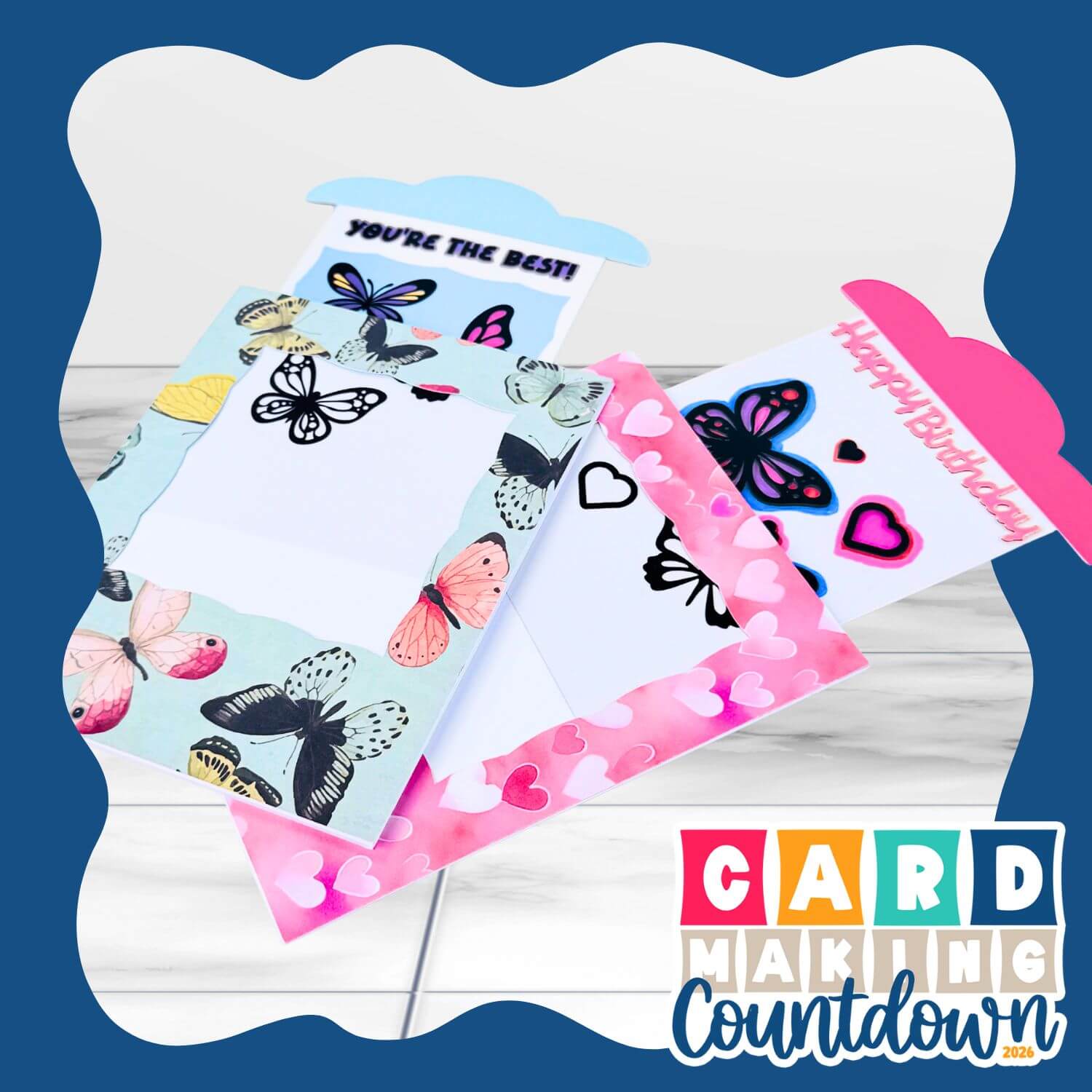
Fun interactive cards for any occasion
I hope you enjoy making these magic color cards.
The mechanism of putting them together is fairly simple, but they are really effective and something a little bit out of the ordinary for your card making projects.
Put your card in a custom envelope or 3D presentation box to make it even more special.
Happy crafting,
Sarah x